


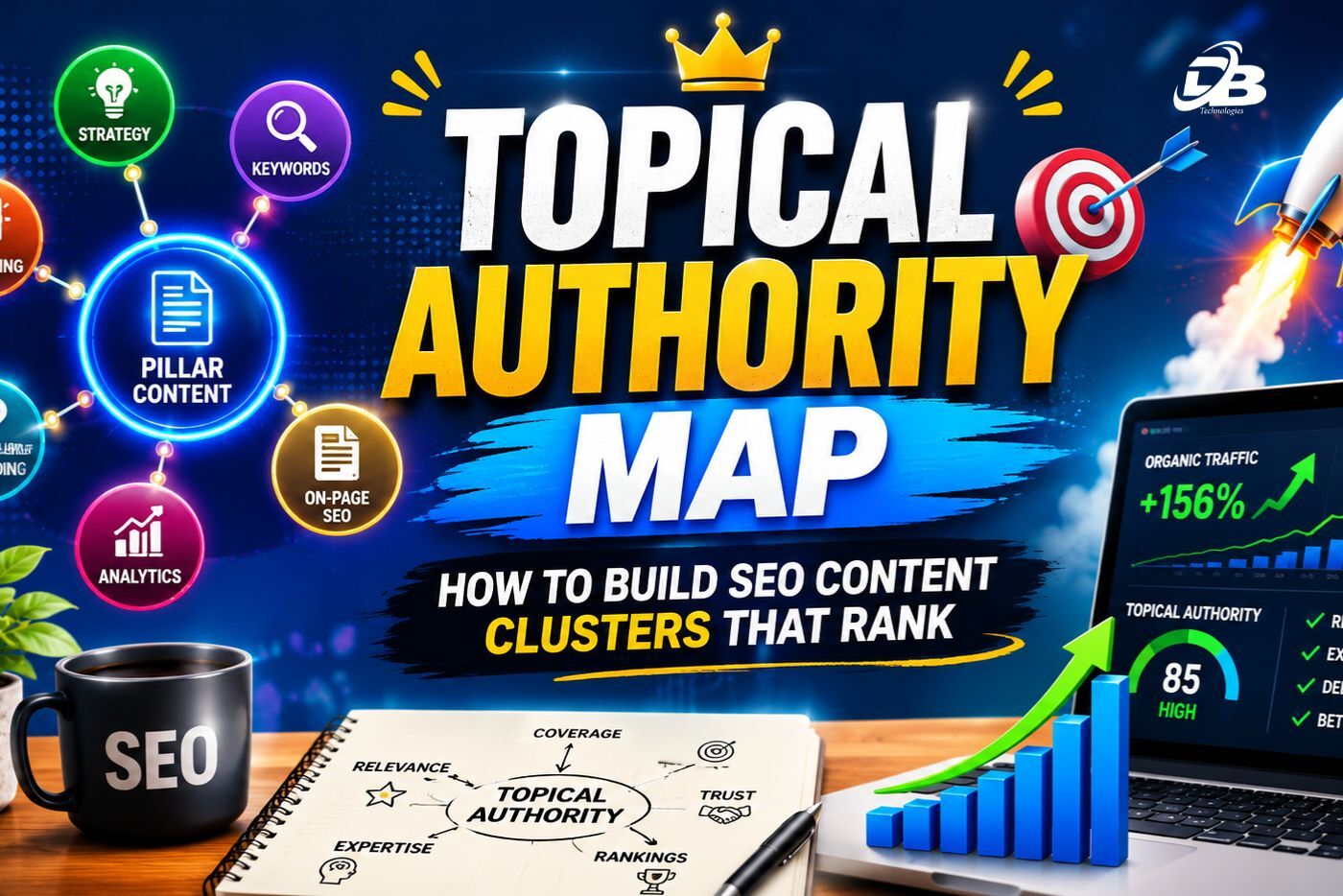
I have wasted lots of time on this one. It was published regularly, optimized titles, ticking every on page checklist item off and there was no traffic spike. Turns out the problem wasn’t any individual post. It was that nothing connected to anything else. No structure. No signal to Google that the site had any real depth on a topic.
A topical authority map fixes exactly that. And building one is less complicated than the name suggests.
What Is a Topical Authority Map?
You’re not looking at a calendar of what you’re going to post next week, you have a blue print of your site, a structural blue print showing you what topics you want this site to be about, and what subtopics grow out of each of these topics, and how each page relates to each other.
The search engines don’t assess a page all by itself. Patterns matter. A site covering one subject from twelve different angles reads very differently to an algorithm than a site with twelve posts on twelve unrelated topics. One looks like expertise. The other looks like a blog that hasn’t decided what it’s for yet.
Topical authority as a concept has been around for years, SEOs have talked about it forever. What’s shifted is how consistently Google seems to reward it now, and how much clearer the path to building it has become.
Why Random Publishing Quietly Kills Rankings
Most content teams operate on a pretty similar rhythm. Keyword with decent volume appears, post gets written, everyone moves on to the next one. Rinse, repeat. The logic seems sound enough: more posts, more chances to rank.
Where it breaks down is that you end up with orphan content. Posts floating in isolation, not reinforcing each other, giving no signal that the site understands the full territory of a subject. Google notices.
Topic clusters SEO works differently. Instead of isolated posts, you build interconnected groups of content, all anchored by a single “pillar page.” Say the pillar covers Email Marketing. The cluster around it would include dedicated posts on subject lines, list segmentation, re-engagement sequences, A/B testing, deliverability — each one going deep on a single slice. Every cluster page links back to the pillar. The pillar links out to each of them. Search engines can follow the whole structure and understand what the site knows.
A semantic content strategy is really what you’re building. Not writing about a topic, but mapping its full shape.
How to Create a Topical Authority Map for SEO?
No special tools needed here. A spreadsheet works. A Google Doc with a table works. The thinking is what matters, not the software.
Pick your core topics first
Three to five subjects. Not more. These should map to what the business does and what readers are already searching for, not aspirational targets, not “what would be nice to rank for someday.”
Running a project management tool? Core topics might be project planning, team collaboration, agile methodology, remote work. Four is plenty to start. Going beyond five in the early stages usually means thin coverage across all of them, which is worse than deep coverage of fewer.
Find what lives under each topic
For every core topic, spend real time understanding what people search for within it. Keyword tools help like Ahrefs, Semrush, even free options. But Google itself tells you a lot. Type the topic into the search box, then check out “People Also Ask” and scroll down to “Related searches” at the bottom of the search listing. These aren’t just any old ideas. Google is showing you the questions your audience keeps asking.
Search intent matters here too, and its worth thinking carefully. Someone searching “what is agile methodology” wants a clear explanation. Someone searching “agile vs scrum for small teams” is comparing options and probably weighing a decision. Different pages serve different intent types, and a strong topical authority map will eventually cover all of them. Not all at once — but the plan should account for where the gaps are.
Check what you already have before writing anything new
Skipped constantly. Shouldn’t be. Go through existing content first. Odds are some posts are halfway to being solid cluster pages and need updating plus proper internal links rather than replacing. Odds are also that some posts overlap so heavily with each other that they’re competing for the same rankings, which is keyword cannibalization, and it quietly eats into topical authority.
Map existing content against the planned clusters. Assign what fits. Flag anything that overlaps badly for a merge or redirect. Then you’ll know what actually needs to be written from scratch versus what needs work.
Build the document
For every core topic, record the pillar page title and its keyword, each cluster page title with its keyword, which pages link where, and status — live, needs updating, or not yet written.
That document is your content plan now. Share it with whoever writes for the site. Refer to it when commissioning new pieces. Update it when things change. Without it, content decisions happen in a vacuum and the structure starts to drift.
Publish the pillar before the cluster pages
Order matters. Cluster pages published before the pillar exists are linking to a gap. The pillar is the structural center — get it live first, or update an existing post to serve that role, and then build the cluster pages around it. When cluster pages’ link to a pillar that’s already established, they reinforce it. The pillar gives cluster pages’ context. Both benefit.
Why This Matters for AI Search Too?
AI-powered search tools have changed how content gets surfaced. Google’s AI Overviews, Perplexity, ChatGPT with web browsing — none of them work quite like the ten blue links did. They synthesize answers from sources they’ve deemed comprehensive and credible on a topic.
Content architecture for GEO (Generative Engine Optimization) has become its own conversation because of this. Interestingly, though, what works isn’t dramatically different from what’s always worked. Covering a subject thoroughly, connecting content coherently, demonstrating real depth — these things get rewarded whether the system surfacing results is traditional search or an AI assembling a response.
Topic clusters for AI search help for a specific reason: a well-structured cluster gives AI systems more to work with. Having a site dedicated to agile methodology is much better if a system is building an answer on agile methodology than one site with one general overview. The wide-ranging scope indicates that this website is not talking about the superficial aspects of the topic, but rather the deep, underlying components of it.
A topical authority map, built well, positions a site for both environments at once.
Mistakes to Know About Before Starting
Going too broad too fast. The pull toward covering everything is strong, especially when competitors seem to publish on every topic under the sun. Ten half-built clusters will almost always lose to three thorough ones. Narrow focus first, expand later.
Forgetting to actually add internal links. Content clusters only work if the page’s link to each other. A well-planned map means nothing if the posts on the site aren’t connected. Go back through published content and add links. Unglamorous, time-consuming, worth doing.
Cluster pages that step on each other. Two posts with almost the same topic take the place of the authority that belongs to one post. Don’t have two pages planned to overlap more than about 40%, they should be combined or one must have a much more focused scope. Ensure each subtopic is clearly individualized to allow for a page to have its own ‘territory’.
Taking the map as a completed product. Search behavior shifts. Some topics that were well under-represented a year ago may be worth a full cluster this year. Old posts go stale. Review the map periodically, not from the beginning, but to see if it still represents the site’s needs, every quarter or so.
If you find yourself with a blank sheet of paper, here are some tips on how to get started
One topic. The single most important one to the business.
Take some time to sketch out the subtopics. Compare against existing web site. Find the gaps. Write the pillar page if it doesn’t exist. That’s the whole first phase, not a small lift, but a finite and manageable one.
Results from this approach tend to come faster than expected, and the reason is pretty simple: most websites, including well-resourced ones, still don’t operate with a coherent semantic content strategy. They publish. They optimize pages individually. Connected architecture is rarer than it should be. Doing it well stands out.
One cluster, built with real depth and proper linking. Then the next one. That’s how a topical authority map gets built — and for most sites, it’s also how search traffic that doesn’t depend on luck gets built.




 +971 582 871635
 +971 582 871635