


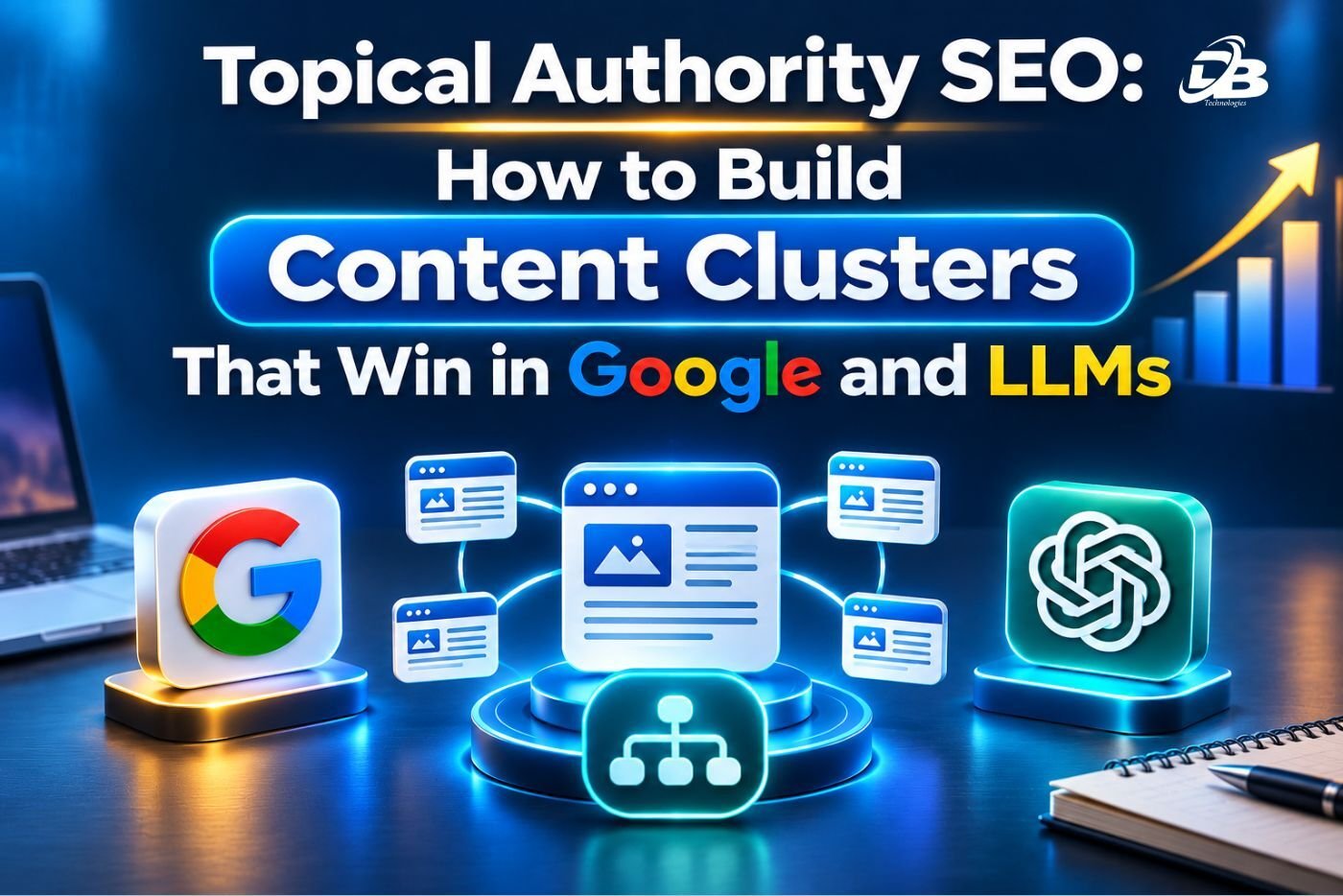
Topical authority SEO is about becoming the site people trust on one subject. Writing a random post on everything rarely gets you there. Picture a business with 40 blogs, each one chasing a different keyword. Chances are, most of them are sitting quietly on page four.
Bad writing isn’t always to blame. Quite often the pages have nothing to do with each other. A reader finishes one article, finds nothing useful to read next, and off they go.
Search habits are shifting too. In Google or ChatGPT, people can ask long questions and expect proper answers. Content clusters can help your site earn a place in them. Here’s how to plan yours.
What Is Topical Authority SEO?
At its simplest, topical authority SEO means covering one subject so well that people see your site as a reliable place to learn it. You answer the big question, then the smaller ones hiding behind it.
Take an agency that offers local SEO. A post on “what is local SEO” is useful, sure. But what about Google Business Profile? Or how a business should handle its reviews? Answer those questions too, and readers have a reason to stick around.
Here’s the awkward part: Google doesn’t show you a topical authority score. It has described a “topic authority” system, although that was for news queries on subjects such as health, politics or finance. So when an SEO tool gives you a score, treat it as an estimate, not Google’s verdict.
Think of authority as something you earn. Useful depth, first-hand experience, sensible links and a good reputation are all likely to help. Volume on its own is a weaker bet. A focused site with less pages can be far more helpful than a huge one stuffed with thin posts.
How Content Clusters and Pillar Pages Work
Content clusters are sets of related pages that sit around one main topic. There are three moving parts.
– The pillar page is your broad guide to the main topic.
– Around it sit the cluster pages, each digging into a narrower question.
– Internal links tie everything together, so readers are less likely to hit a dead end.
Readers get the big picture from the pillar, then follow a link for more detail. From there they can head back or jump to a related article.
A simple content cluster example
So how might an agency plan a local SEO cluster? Perhaps like this.
Page | Question it answers | Links to |
Pillar: Local SEO guide | How does a local business get found online? | All cluster pages, Local SEO & AEO service |
Cluster: Google Business Profile | How do I optimize my business profile? | Pillar, reviews |
Cluster: Citations and directories | Where should my business be listed? | Pillar, on-page local SEO |
Cluster: On-page local SEO | What should my local pages include? | Pillar, Google Business Profile |
Cluster: Review management | How should I handle customer reviews? | Pillar, Google Business Profile |
Cluster: Local vs regular SEO | How is local SEO different? | Pillar |
Every page in that table has its own job. If two would answer the same question, merging them is usually smarter. Otherwise they may compete (and confuse readers).
A pillar page doesn’t have to be a monster. Giant guides can be tiring to read, so give enough detail to guide someone, plus a clear route to the rest.
Why Content Clusters Matter for Google and LLMs
Links help Google discover pages and work out what’s relevant. According to its link guidance, every page you care about should have a link from at least one other page on your site. With a planned cluster, that’s easier to keep on top of.
Then there’s AI search. Google’s AI features use query fan-out, which means running several related searches to help build one response. Google’s AI optimisation guide gives an example. For a question about a weedy lawn, the system may also look up herbicides or chemical-free weed removal.
What the research shows
In March 2026, an Ahrefs study looked at 4 million URLs cited in AI Overviews. Only 37.9% also ranked in the top 10 for the same search, down from about 76% in July 2025. About 31% sat beyond the top 100. Ahrefs links the fall to fan-out searches, but its tracking also improved.
Research from Surfer leans the same way. Among cited pages that ranked in search, 51.2% ranked for the main query plus at least one related sub-query. For the main query alone, the figure was 19.6%.
How much should you read into this? Some, but not too much. Both companies sell SEO software, and both findings concern AI Overviews. They don’t prove the cause or show how every large language model (LLM) picks sources.
Still, the practical lesson seems reasonable. If you answer follow-up questions well, you may have more chances to be found. And according to Google, SEO basics continue to apply to its AI features.
A Pillar Page Strategy in 6 Practical Steps
Resist the urge to open a blank page. A good pillar page strategy begins with planning, and the writing comes later.
1. Pick a topic close to your business
Your topic should connect what you sell with what you know. For an agency offering local SEO, “local SEO” fits nicely. “Marketing”? Far too wide. A handy test is to ask, would a customer come to us for advice on this?
2. Collect real questions
Sales calls, support emails and customer chats are a goldmine because they show how people word problems. Next, check Google’s “People also ask” box, Search Console or your keyword tool. AI tools can suggest ideas too. Treat those as guesses until you’ve verified them.
3. Group questions by search intent
Now search your questions. When two phrases bring up almost the same results, one article can probably cover both. Very different results are a hint that you may need separate pages, although your own judgement still matters here.
4. Audit what you already have
A plain spreadsheet works fine. List every related URL, then mark it keep, update, merge or create. You might discover that half a cluster already exists, scattered across old posts. If a page gets merged or removed, redirect its URL to the closest useful one.
5. Write pages that add something new
Each of these pages need a good reason to exist. What can you show that a rival can’t easily copy? Your own screenshots, test results or lessons from client work are strong options. Google’s guide also favours unique, first-hand content over generic advice. An agency could show a business profile before and after an update, with the client’s permission, then explain what changed.
6. Link the cluster properly
Place links inside the text, at the point where a reader is likely to want more help. “How to optimize your Google Business Profile” tells them what they’ll get, while “click here” tells them nothing. The pillar should link to every cluster page, with a link coming back from each. Also look for orphan pages that nothing points to.
How to Make Your Content Clusters Useful to AI Search
No one can promise you a citation in an AI answer, so be wary of anyone who says they can. What you can do is make your pages easier to find, read and trust.
– Answer early. Give a short reply first, then explain.
– Clear headings let a reader jump to the part they came for.
– Who wrote this? Show the author, their experience and an honest update date.
– When you quote a number, link to the original source where you can.
– Don’t forget crawler access. For Google’s AI features, key pages must be indexed and able to show a snippet. If ChatGPT search matters to you, OpenAI advises allowing OAI-SearchBot in your robots.txt file.
– Keep prices and other facts consistent across your site.
Some popular advice can be skipped, at least for Google. Its guide says there’s no need for an llms.txt file, special AI schema or content chopped into tiny chunks. Keep your normal structured data, though, as it can still help with rich results. Other AI platforms may work differently, so test them.
Common Mistakes and How to Measure Progress
Mistakes that weaken a cluster
Probably the biggest trap is spinning up a new page for every tiny change in wording. Google warns that producing pages like this mainly to manipulate rankings or AI responses can break its spam rules. Fan-out searches are research clues, not an order to publish hundreds of near-copies.
Other slip-ups are quieter. A team launches its pillar, gets busy, and the supporting pages never arrive. Or links get dumped at the bottom of a post in the hope that someone clicks. Old advice is a risk as well, so give every page an owner plus a review date.
What to track
Single pages only tell part of the story, so judge the cluster as a group too. A monthly check could cover:
– Search Console clicks and impressions across all cluster URLs
– How wide a range of relevant searches you appear for
– Whether visitors move from one cluster page to another
– Any enquiries, sign-ups or sales involving these pages
– Mentions or citations in AI tools (ask the same questions every time)
AI answers can change, so one screenshot proves very little. Note the date, tool and prompt, and watch for a trend over several months. Traffic is nice, but the right visitors matter more.
And the timeline? There isn’t a fixed one. Competition, site history or content quality can affect it. Don’t wait for every page to be perfect, publish a strong first group and keep improving it.
Start Small, Then Build Your Authority
A hundred articles can wait. Begin with one topic your customers care about, map five to eight real questions, then fill the biggest gaps.
That is the heart of topical authority SEO. With content clusters, your knowledge gets a clear shape. A pillar page strategy helps people find their way through it. Neither one will rescue a weak answer, though.
So why not open a spreadsheet today and jot down the ten questions customers ask you most? Your first cluster might be hiding in there.



 +971 582 871635
 +971 582 871635