

Want to know where you stand with AI? Ask ChatGPT for the best option in your industry and count how many names appear before yours, if yours appears at all.
Probably not, and honestly that stings. You’ve got a decent website, a blog that gets updated, maybe even a few happy reviews. Yet the AI acts like you don’t exist.
The reason is usually boring: it just hasn’t seen your name often enough, in enough of the right places. Digital PR for AI search is how you change that.
Search used to be a list. Now it’s one answer
Google shows ten links and people wander through them. ChatGPT, Gemini and Perplexity write one answer and most people read that and move on. There’s no in between.
How those answers are created isn’t something known to anyone outside the AI labs. Anyone who claims to have the full formula is selling something. What we can see, after running enough test prompts, is that brands which get named tend to be the ones other websites keep mentioning next to the same topic. Again and again.
So the goal shifts a bit. Instead of only asking “how do I rank for this keyword?”, you also ask who is talking about you, and where.
Where these tools seem to look
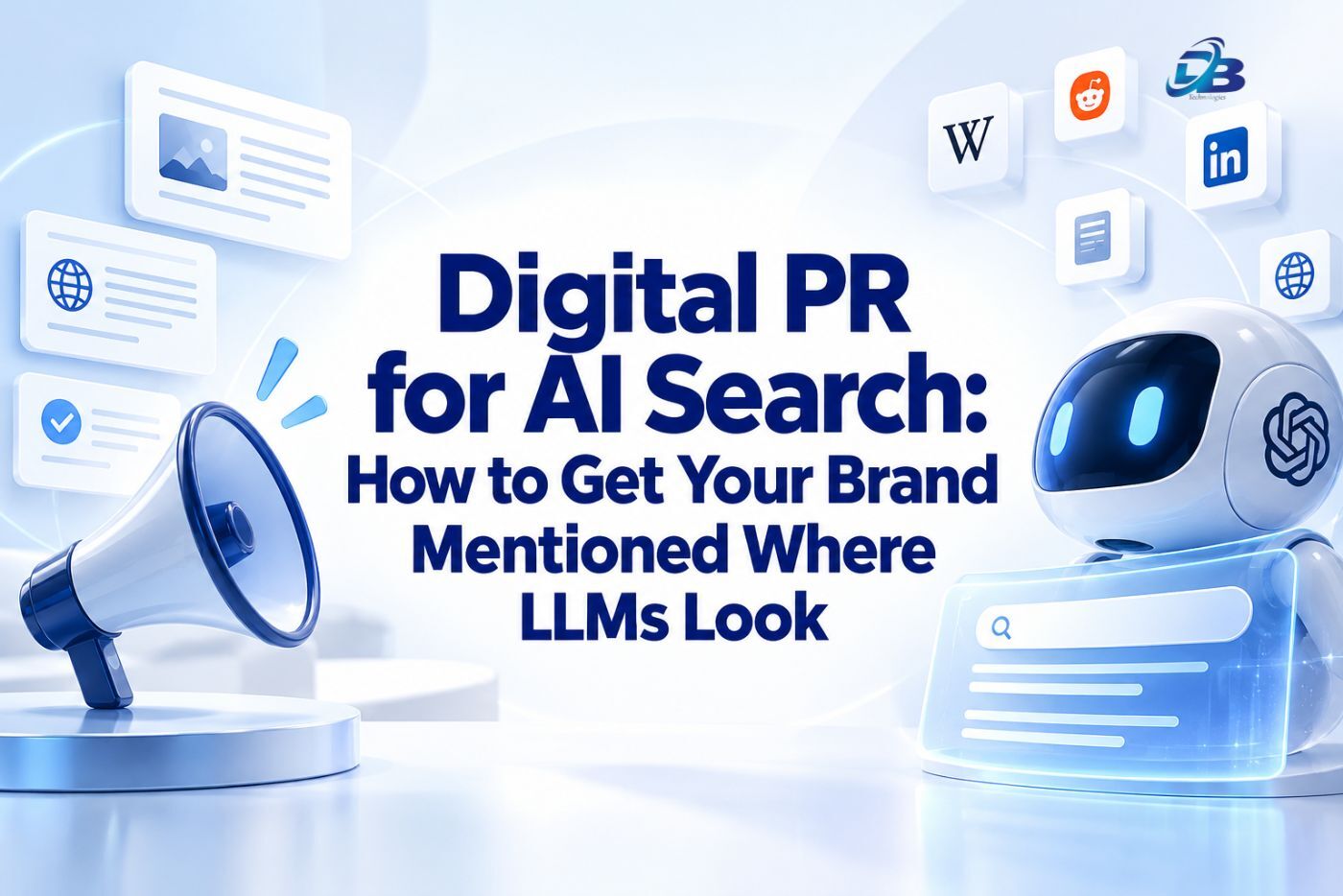
Models learn from a giant pile of text, and a lot of AI search tools also pull in live web pages when they answer. From what shows up in citations, the regulars are news sites and trade magazines, review sites like G2 and Trustpilot, Wikipedia, Reddit and Quora threads, “best of” roundups, and transcripts from podcasts and YouTube.
Notice what’s missing? Your own site, mostly. It still matters, of course, but a model seems to trust other people’s words about you more than yours. You’d do the same. Picking a restaurant, you’d ask a friend before reading the menu on the door.
Brand mentions SEO: words, not just links
The old SEO story was all links. Someone links to you, that counts as a vote, collect enough votes and you climb. Fine, and I wouldn’t bin your link-building plan.
But an AI model reads, however. It doesn’t follow a hyperlink, like a crawler would, it reads the sentence around it. If your brand name continues to be found next to something like ‘commercial dishwashers’ or ‘care home hygiene’ or something your thing is, the model might begin viewing the two as a couple.
Ten solid articles naming you in that setting could do more for AI visibility than one link tucked into a footer nobody scrolls to. Can I prove it? No. Small tests by a few agencies lean that way, and it fits how the technology works, so it’s a reasonable bet.
That brand mentions SEO in a nutshell. Authority scores count, sure. What’s new is the pattern of association you build across the web.
One warning while we’re here: plenty of articles on this topic promise guaranteed spots in AI answers. Don’t believe them. Nobody can guarantee that. This is the heart of brand mentions SEO.
Unlinked brand mentions still count
A journalist quotes your founder and forgets the link. A blogger lists you in a roundup, typing your name in plain text. A podcast host just says your company name out loud. These are unlinked brand mentions, and marketers tend to treat them as a half-win.
For AI visibility, I’d call them a win. The text is still there, your name still sits next to the right topic, and a missing hyperlink doesn’t erase that. Take it. Then ask for the link if you feel like it.
What to do this week
You need a starting point . You can’t improve something you haven’t examined. Record who is mentioned and which source is mentioned in the citations, as you ask ChatGPT, Gemini, Perplexity and Copilot the questions your customers would type, like: what’s the best [your category] for [your audience]? Twenty minutes, tops. At the end, you’ll have an approximate idea of which publications these tools rely on, and that is your very own PR target list, which you’re getting for free.
Then observe the loser(s) next. If one competitor appears in all the answers, discover which articles mention him/her, which podcasts has he/she appeared on, and in which lists has he/she been added. You’re not copying. You’re spotting which doors are already open.
Then there’s the bit everyone wants to avoid, creating something worthy of being mentioned.
Naming of brands doesn’t happen by chance. They do it when you give them a new number, a sharp opinion or a free tool. Suppose you have a small bakery and you ask your 200 customers which flavour they wouldn’t ever want to try again. Then write up the silly answer and send it to some food bloggers, see what they do. Each one of your stats quoted is another mention, and a small survey is very inexpensive.
It is a skill all on its own. Skip “Dear Sir/Madam.” Read something you wrote last week (or in last week’s lesson), tell the person, and explain it for two sentences as to why it is a good idea for your reader. Rewrite email that you wouldn’t send to yourself.
Expert-quote services are worth a look too. Journalists post requests, you answer the ones in your area with short, clear replies, and when your founder gets quoted in a decent outlet you pick up a mention plus a link in the reader’s head between you and the subject. Podcasts work in a similar way: one forty-minute chat becomes a transcript, and that’s a lot of extra text with your name in it.
Get onto the roundups
A lot of AI answers read like a summary of listicles. So be on them. Find the authors of “best [category] tools” posts and ask to be considered, and make it painless: one-line description, a screenshot, done. Busy writers say yes more when you’ve done half the work.
Keep your details identical everywhere
Boring, but it matters. When one website is called “Northwind Studio” and a second website is called “Northwind Digital Agency”, there’s a good chance that it’s two different companies. Select one of the short descriptions, and use it on all your website, social profiles, and press kit.
Help Communities, by volunteering your time.
Niche forums, Reddit, LinkedIn Groups. Be accurate, give knowledge and information and only speak about your brand when it is pertinent. Anyone can feel a plug the moment they start smelling it. This is more of a problem than not talking about it at all.
Chase the missing links
Come up with a name for your brand and set up Google Alerts for that name, or if the budget permits, purchase a monitoring service. If an unlinked mention is made, breve note is sent: “Thanks for including us! If it’s okay, do you mind posting a link to our site, so readers can visit us as well?” Most say yes.
What this looks like in real life
Picture a small company selling shipping containers. Month one, they test the AI tools and find that three trade blogs get cited again and again. Month two, they send those blogs a short piece of data about container prices across regions.
One blog bites, quotes them, and doesn’t link. Month three, a podcast host reads the article and invites their founder on. Nothing dramatic happens in any single month. But by month six, a handful of respected pages say the same thing about them, and the AI starts repeating it.
That’s the whole game, really. Slow, a bit unglamorous, and surprisingly doable for a small team.
Not all mentions are equal
Alerts pinging all day feel great. Don’t get carried away, though. A random name-drop in a list of 50 companies is fine. A sentence that says what you do and who it’s for is far better, because it ties you to one topic.
Context matters as well. A mention in an article about your own industry beats one in some vague “cool companies” post. If a writer asks you what they can say about you, tell them exactly, such as “a UK supplier of architectural ironmongery” and not a “supplier. Tiny change. This is likely to be an actual difference.
How will you know it’s working?
Messy question. No official AI rankings report, so you will create one for yourself: re-run your test prompts every month and tally the number of times you are mentioned; keep an eye out for branded search (when more and more people are mentioning it); look at analytics for referral visits from AI tools; let your alerts count the number of mentions, on or off links.
Don’t expect quick results. Digital PR for AI search is more like planting a garden, don’t take it like light switch. Mentions pile up quietly for weeks, and then one day an AI tool suggests you and you realise it’s working.
Ways this goes wrong
Fifty mentions on junk sites won’t do much, while three on respected publications mightSpammy placements and fake reviews may rebound, as the models become more adept at identifying them. Mentions can’t help thin or slow sites. By all means don’t stop after 30 days. That’s not enough.
So, where to begin?
AI tools are becoming the front door for brands, and it appears they’re choosing their target audiences based on what the rest of the internet is saying. Provide the web with a good message.
Start small. See how it’s saying about you now, figure out the sources it’s relying on and head there to make some of your own mentions, deliver some pitches and clean up some brand info. Watch for those not linked mentions as you go. Do that for a few months and next time a customer asks an AI for a recommendation, your name might well be in the answer.


 +971 582 871635
 +971 582 871635