

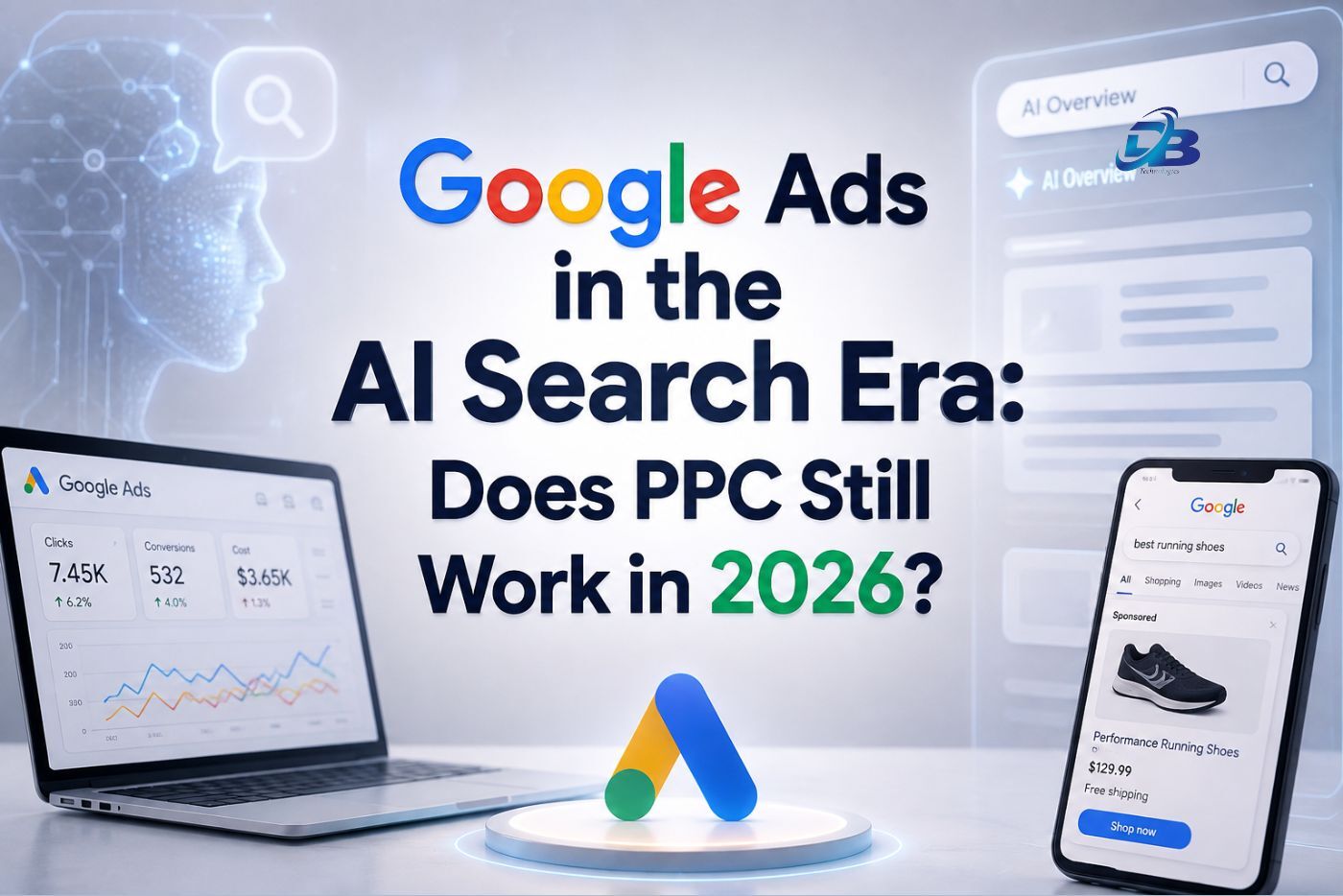
If you run ads on Google, this year probably felt off somehow. CTRs go up and down for seemingly no reason, the result page doesn’t even resemble what it was two years ago, and there’s a good chance that someone in your team already asked if Google Ads 2026 is the same platform as it was two years ago.
It’s a fair thing to wonder about. AI Overviews show up on nearly every search now. AI Mode actually lets people go back and forth with the search engine instead of just typing a phrase and scrolling past ten links. Which leads to the question at hand: Is PPC still worth it, or are marketers throwing money at a place where it’s slowly dying?
Short answer: still worth it, no question there.
The longer answer is that the rules shifted underneath everyone, and the accounts still running on the old playbook are exactly the ones watching their CPCs climb right now.
Let’s get down to what is changed, and what you can do about it.
What Changed: A Quick Recap
Google has been rolling AI Overviews and AI Mode into more and more searches. McKinsey reported that roughly half of U.S. consumers are now intentionally using AI search tools, and AI-generated summaries show up in about half of Google searches too. That’s not a small shift, that’s a search engine mid-transformation.
Here’s the part that matters for advertisers: ads can now appear above, below, or inside AI Overviews. Google has expanded eligibility for these AI-powered placements through Performance Max, Shopping, broad match Search campaigns, and something called AI Max for Search. eMarketer expects U.S. spend on AI-enabled search advertising to jump from roughly 1.3% in 2026 to 13.6% by 2029.
So the ad inventory hasn’t vanished. It’s moving. And it’s tangled up with how AI systems interpret your website in ways that traditional keyword targeting never had to worry about.
Is PPC Still Worth It? Yes, But Ask a Different Question
I’ll be honest, the “is PPC still worth it” debate online is a bit lazy. It treats PPC like a single dial you either turn up or down. That’s not really how it works anymore.
Google makes something like $198 billion a year in ad revenue. It’s not going to build a shiny new AI search experience that torches its own income. What’s more likely, and what we’re already seeing, is that paid placements stick around and possibly get more competitive as organic real estate gets squeezed by AI Overviews eating up screen space.
So the better question isn’t “should I still run Google Ads .” It’s “is my account built for how people search now.”
Rigid keyword lists, a single landing page stretched across five different campaigns, conversion tracking that barely scratches the surface, none of that was ever a winning setup, but it used to just cost you a bit of efficiency. Now it costs you the account.
Why AI Search Changes the Way You Should Think About Keywords
Queries have gotten longer, and honestly, more interesting. Nobody’s just typing “best running shoes” anymore. They’re asking AI Mode something closer to “what running shoes actually help with knee pain if I’m training for a half marathon and overpronate.” That’s not a keyword. That’s basically a paragraph with a question mark on it.
And that’s exactly why the old approach breaks down. Google’s AI is no longer just searching for a keyword, it now searches the entire question, and the AI created context surrounding it. The kinds of exact match lists that were established five years ago, and are tight and narrow, don’t fit very well into that conversational style. You end up missing traffic that would’ve converted, simply because the algorithm never connected your ad to the underlying intent.
Practical tip: Pull your search terms report and actually read the long, oddly specific queries triggering your Google ads 2026 right now. Not the top ten by volume, the weird long ones buried at the bottom. That’s where you’ll see the shape of how real people are asking AI-assisted questions today, and it should inform your ad copy and landing pages more than your keyword list does.
Your Website Content Now Doubles as Ad Material
Here’s something a lot of advertisers haven’t clocked yet. With AI-generated ads, Google can assemble the actual ad from your website copy, your product feed, and your marketing materials, rather than from a headline and description you typed into the ads dashboard yourself.
Which means bad, thin website content doesn’t just hurt your SEO anymore. It hurts your paid Google ads 2026 too, because the AI drawing from that content produces a weaker ad. Ken Braun from Lounge Lizard put it well when he said this places more value on structured, factual, question-based content. Clear headings, original information, useful visuals, and well-organised product details all help an AI system understand and represent your page correctly.
A few things worth doing here:
– Write actual FAQ sections that answer real customer questions, not vague marketing fluff
– Keep product pages detailed and current, since thin pages give the AI less to work with
– Use comparison content where it makes sense, since people are asking AI to compare options for them anyway
– Structure content with clear headings so both humans and machines can scan it quickly
Smart Bidding and Automation Are Doing More of the Driving
Manual bid adjustments every morning used to be a core PPC skill. That’s fading fast. Performance Max is taking on more of the targeting, bidding, and creative decisions itself, and AI Max is expanding how standard Search campaigns discover queries and build ad assets on the fly.
This is where a lot of advertisers get nervous, and honestly, some of that nervousness is earned. Automation only performs as well as the data you feed it. If your conversion tracking counts every form submission as a win, Google’s algorithm will chase more form submissions. Even the junk ones. I have seen pages with 70% spam or tyre-kickers and the bidding system working for months to optimise for “the wrong audience.
Practical tip: Create a more in-depth conversion funnel within your tracking rather than only “lead submitted. A more realistic conversion path would be lead to qualified lead to opportunity to customer. The more you can tie ads to real revenue, the smarter the automation will become, since it is now optimising for results – not vanity metrics.
What About AI Overviews Eating Your Clicks?
This one’s real, and it’s worth naming directly rather than dancing around it. AI Overviews tend to reduce paid impressions more than they reduce organic visibility, mostly because only organic citations get pulled into the actual answer card. If someone’s question gets fully answered inside the AI summary, they may never scroll down to your ad at all.
That said, this doesn’t mean every click is lost. It means the click that matters most now often comes from someone who’s already done their initial research inside AI Mode and is arriving with sharper, more decided intent. Fewer total clicks, but potentially higher-quality ones. Whether that trade works in your favour depends heavily on your industry and how considered the purchase is.
Practical tip: Track impression share and on-page visibility as seriously as you track raw click volume. If your impressions are steady but clicks are dipping, that’s often the AI Overview effect, not a sign your ads are performing worse than before.
A Real Look at What’s Working Right Now
From what agencies and practitioners are reporting through mid-2026, a few patterns keep showing up.
Journey-aware bidding, where Google’s system learns from more of the lead-to-sale journey using both primary and supporting conversion goals, is genuinely helping accounts that feed it clean data. A valid concern, however, was raised by one practitioner on a PPC forum, who said that sometimes when your conversion data doesn’t really reflect on the quality of a sale, AI Max can go for lower-intent traffic, which may be cheaper. This is no excuse to not use the tool. It’s a reason to double down on getting your conversion signals right before you lean on it heavily.
Enhanced conversions and tighter AI messaging controls also came up a lot around Google Marketing Live 2026. Those who did bother to set them up correctly are watching more numbers than those who are running them the old fashioned way.
So, Should You Still Run Google Ads in 2026?
Yes. Genuinely. Google Ads 2026 rewards accounts willing to rebuild, not coast , so treat this as a rebuild moment, not a normal quarter.
The accounts struggling right now are stuck in 2022 habits. Tight exact-match lists. One landing page trying to do the job of six different campaigns. Conversion tracking that counts anything with a submit button as a win, junk leads included. None of that was ever really good practice, if we’re being honest, it’s just that AI search finally stopped letting it slide.
The accounts doing well are treating their website content as part of the ad, feeding automation with real business outcomes instead of shallow form fills, and paying attention to impression share and AI visibility alongside the usual click metrics.
Paid search isn’t dying. It’s getting pickier about who it rewards. If you’re willing to put in the work on content quality and conversion data, there’s a genuine argument that 2026 rewards good PPC practice more than any year before it. The lazy accounts are the ones about to have a rough time, and honestly, that’s probably a healthier market for everyone left standing in it.
What To Actually Start Doing
If you must take just three things from the entire text, make it these three things:
– Audit your search terms report for the long, conversational queries you’re already ranking for and adjust your copy to match that intent
– Tighten your conversion tracking so it reflects real business outcomes, not just form submissions
– Treat your website content, especially FAQs and product pages, as an extension of your ad account, because with AI-generated ads, it quite literally is
PPC in 2026 isn’t a simpler game than it used to be. But treating PPC AI search as one continuous strategy, not two separate problems, is what separates the accounts still growing from the ones quietly losing ground. .


 +971 582 871635
 +971 582 871635