

Most content about link building is written by people trying to sell you link building.
To be upfront.
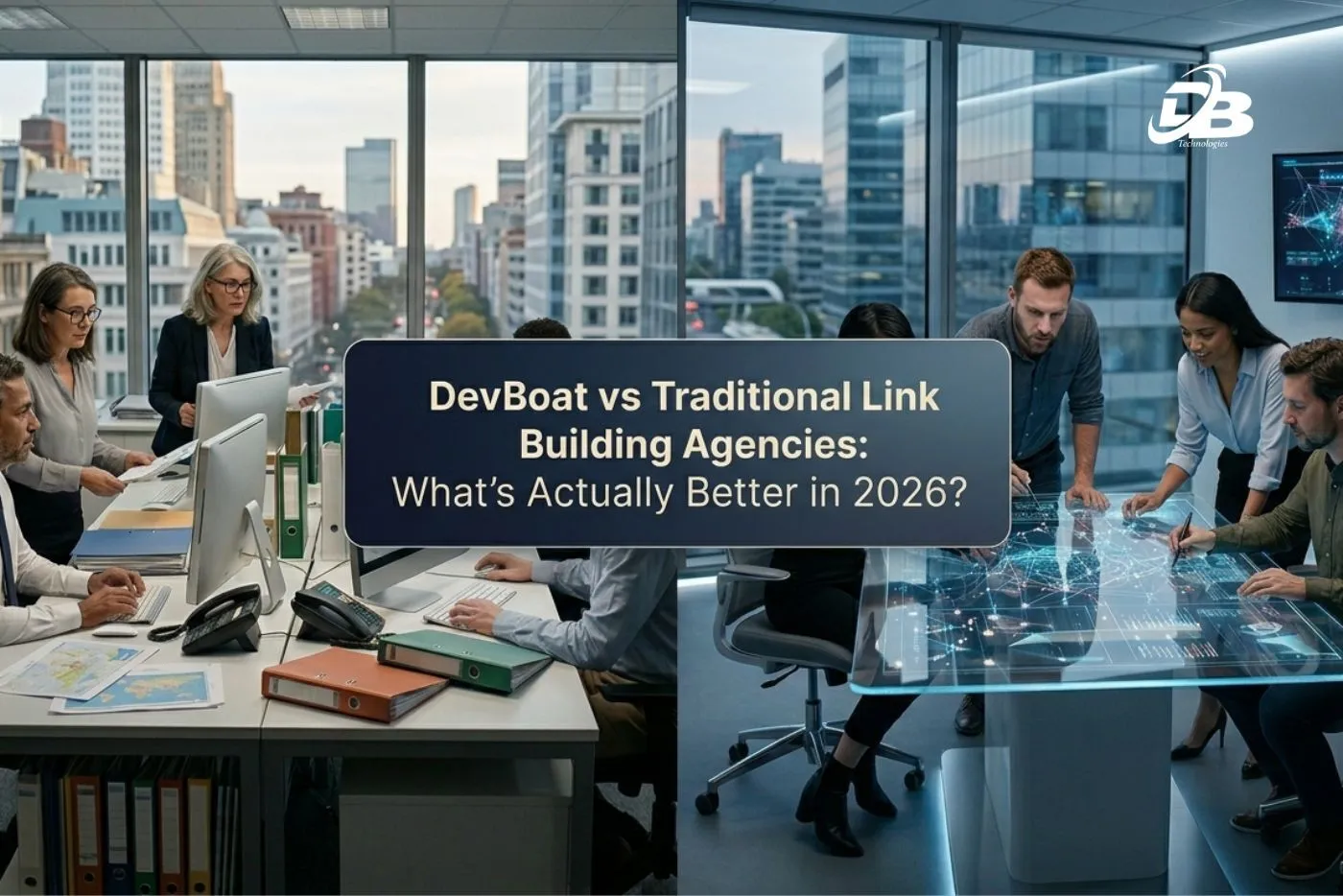
By the time you do a good link building agency comparison in 2026, you will have likely realized that the world of SEO will have changed significantly compared to the way it used to appear two or three years earlier. Google has become more context sensitive. The web is being flooded with AI content. And many of the tricks that used to shake the needle? They are no longer working, or are furtively setting up trouble on the sites which depended on them.
So before you sign up for anything with DevBoat or any other traditional agency, it’s worth understanding what actually separates modern link building from the old playbook. Because they really aren’t the same thing anymore.
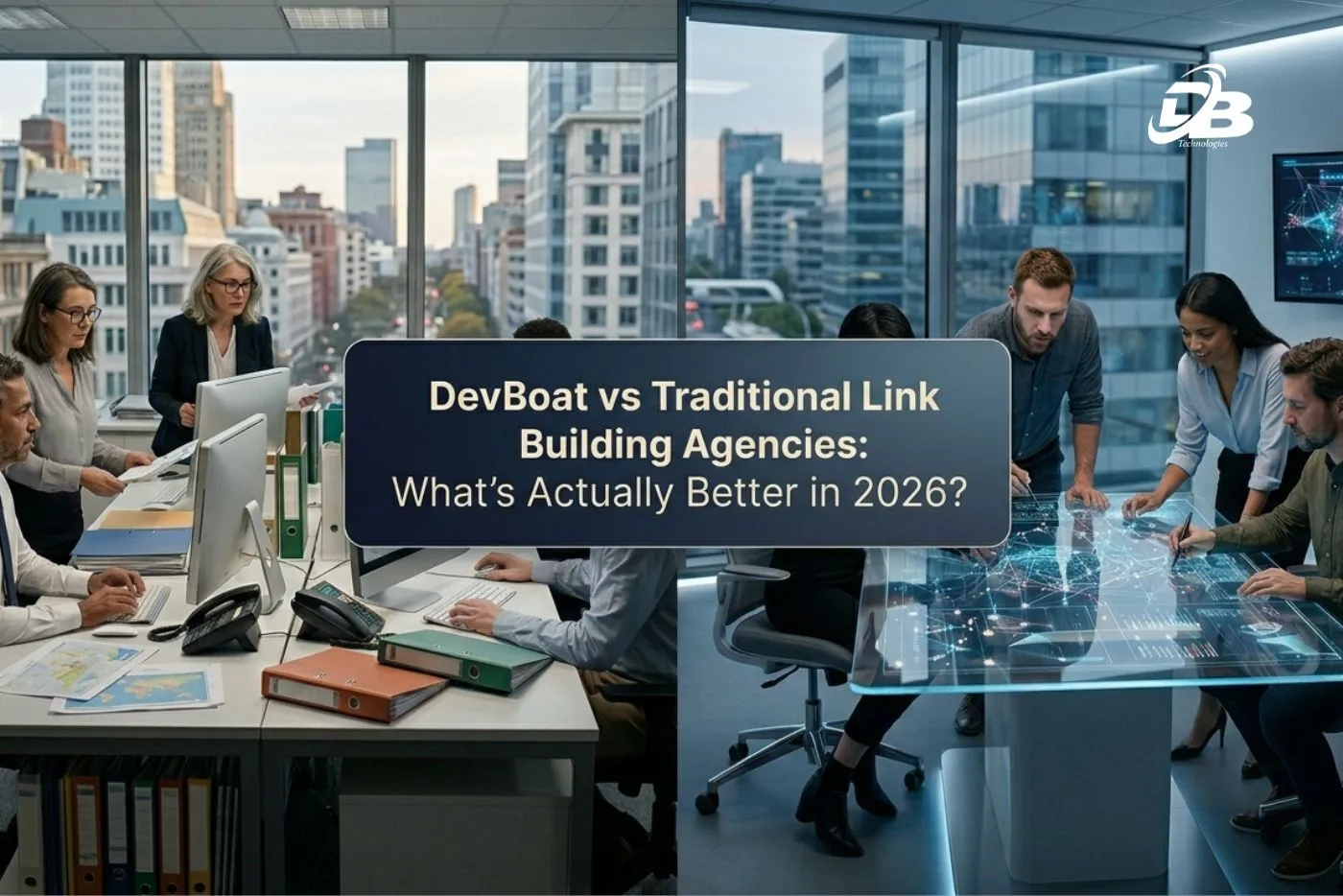
Link Building Agency Comparison: What Traditional Agencies Actually Do?
The model is fairly predictable.
You pay a monthly retainer. The agency contacts a list of websites, agrees on placement, and a guest post appears on one of them with your link somewhere on the body. You are provided with a list of URLs at the end of the month.That’s not necessarily wrong.
It just tends to be built on assumptions that were more valid in 2015:
– More links = better rankings
– Domain Authority is a reliable signal for link quality
– A guest post is a guest post, regardless of where it appears
Google’s algorithm has moved on from all three. Topical authority, content relevance, the editorial quality of the surrounding article — these carry far more weight than raw link count ever did. A lot of traditional agencies haven’t fully adapted to that, and the ones that have are starting to look less “traditional” by the day.
What DevBoat Does Differently?
DevBoat positions itself as a modern authority link building service, designed specifically as search engines will evaluate links in 2025 and 2026.
The unique selling points are:
Strategy first, outreach second. Audit is built before anything is built, what you have in terms of back links, where are your competitors linking you, what are the topical clusters that you are weak in terms of authority. Links are then built to support that picture. Not to fill a monthly quota.
Niche relevance as a non-negotiable. If you’re a B2B SaaS product, your links should come from publications your buyers actually read , not from a generic “business growth” blog that happens to have a decent domain rating.
Reporting that actually explains something. You should know why a site was chosen, what its organic traffic looks like, and how the placement connects to your ranking targets. A spreadsheet of URLs isn’t a strategy update. It’s just an invoice with extra steps.
The underlying logic is what separates the two approaches — not the tactics themselves.
Niche Relevance Isn’t Optional Anymore
For years, domain authority was treated as the primary signal for link quality. High DA site links to you, rankings go up. Clean, simple, scalable.
That still has some truth to it. But Google has gotten significantly better at reading topical context. A DR70 celebrity gossip site linking to your SaaS product probably isn’t doing much. A DR45 publication that your target audience reads every week? That one carries weight.
Niche relevant link building is the core of what DevBoat offers — and honestly, it’s what any credible modern link building service should be focused on. The goal isn’t to collect links. It’s to earn them from places where relevance reinforces authority in Google’s eyes.
For SaaS companies especially, this distinction matters. If you’re trying to rank competitive transactional terms in your category, you need links that signal to Google you belong in that conversation.
Random guest posts on lifestyle blogs and “top digital marketing tips” sites don’t do that. They look like what they are — outreach volume for its own sake.
Every agency operates a bit differently, so this won’t be a perfect fit for every case. But these patterns hold up.
How to effectively elevate a link building agency?
No matter whether it is DevBoat or anybody, one thing is worth checking before money changes hands.
- Request recent placements, not a portfolio to pick
You would like URLs that are less than 60-90 days old. It is possible to assemble a list of highlights in 2022 by any person.What matters is what they’re delivering right now. - Run the referring sites yourself
Don’t take DR at face value. Pull the site up in Ahrefs or Semrush. Does it have real organic traffic? Does the information around the link matter to your niche? A DR60 site that has 300 monthly visitors cannot be valued the same as a DR60 site that has 50,000.
- Find out who writes the content
Guest posts live or die by the quality of the surrounding article. If the content is thin, templated, or clearly outsourced to whoever accepted the lowest bid, it shows — and Google can likely tell too. - Understand the placement model
Is this agency undertaking actual editorial outreach, or bribing site owners to place? Paid placements do not mean that it is a red flag, you should be aware of what you are purchasing. When an agency is not clear on this, then that is worth noting.
- Check niche experience specifically
A SaaS link building agency that has worked with SaaS clients knows the landscape. Same applies to finance, legal, e-commerce, health. Ask for examples from your vertical, not just generic case studies.
The meaning of Ai SEO Link Building
The term is bandied about rather carelessly at the moment, and generally with little actual content to it. So it’s worth being specific.
AI SEO link building doesn’t mean generating AI content and submitting it everywhere. That approach is increasingly easy to detect, increasingly likely to get rejected by editors, and increasingly likely to produce links that don’t do much anyway.
What it can mean and what DevBoat reportedly uses AI tooling for, is:
– Scale API competitor profile-based link gap opportunities.
– Ranking outreach targets in terms of its relevance, traffic and authority indicators.
– Making outreach personal on a volume basis that is not offensive as mass mail.
– Tracking how specific placements correlate with ranking movement over time
The AI is doing research and prioritisation work. Not content generation hat distinction matters more than most agencies acknowledge.
The Honest Case for Traditional Agencies
A fair comparison has to acknowledge where the old model still makes sense.
If you’re an early-stage site in a low-competition niche that just needs some baseline link velocity — the volume approach can still work. Traditional agencies tend to be cheaper, faster, and more operationally streamlined. They’ve built placement relationships over years that let them move quickly.
The tradeoff is long-term health of the search engine.
Connections formed with scaled outreach to generic sites, or networks which put editorial and paid in close proximity are dangerous. Google has been fairly consistent about devaluing these patterns over multiple algorithm cycles. Gains built on a shaky foundation tend not to survive major updates.
Authority-based links compound over time. Low-quality links don’t. That’s probably the most useful frame for thinking about this decision.
Commonly Asked Questions About Link Building Agencies
What makes a good link building agency in 2026?
One that leads with strategy, not package tiers. A good agency can explain why a site was targeted — the traffic, the topical relevance, how it maps to your goals — not just what its domain rating is.
How should I approach outsourcing link building services?
Start with your vertical and your timeline.When you are in a competitive SaaS business, it is better to pay more to a niche-experienced specialist. With a low competition niche, and you simply need to build a minimum level of authority, a generalist may work well at least in the short term.
Are white hat link building services really slower?
Usually, yes, in the early months. Building editorial placements on genuinely relevant sites takes longer than mass outreach. But the results tend to hold up better, and you’re not in a constant cat-and-mouse situation with algorithm updates.
What’s the difference between best guest posting services for SaaS vs general guest posting?
Audience alignment. A service that understands the SaaS ecosystem knows which publications developers, ops leaders, and founders actually read. A general service knows which sites accept posts. Those aren’t the same thing.
Which One Is Actually Better?
For most businesses asking this seriously ,especially SaaS companies, professional services brands, or anyone competing in a category with real competition, the modern approach tends to win. Not because traditional link building is worthless, but because the window where volume-first strategies outperform authority-first strategies keeps shrinking.
DevBoat’s approach is closer to where SEO is heading. That doesn’t make it perfect, no agency will deliver results without a solid content foundation and some patience on your end. But if you’re thinking about link building as a long-term SEO asset rather than a short-term ranking lever, the strategy-first model makes significantly more sense.
The best link building agencies today, the ones that actually move rankings in competitive verticals ,all seem to share one thing. They think about links as part of a broader authority story. Not as units to count.
That’s what separates modern link building from the old model. And in 2026, that gap is only getting wider.


 +971 582 871635
 +971 582 871635