

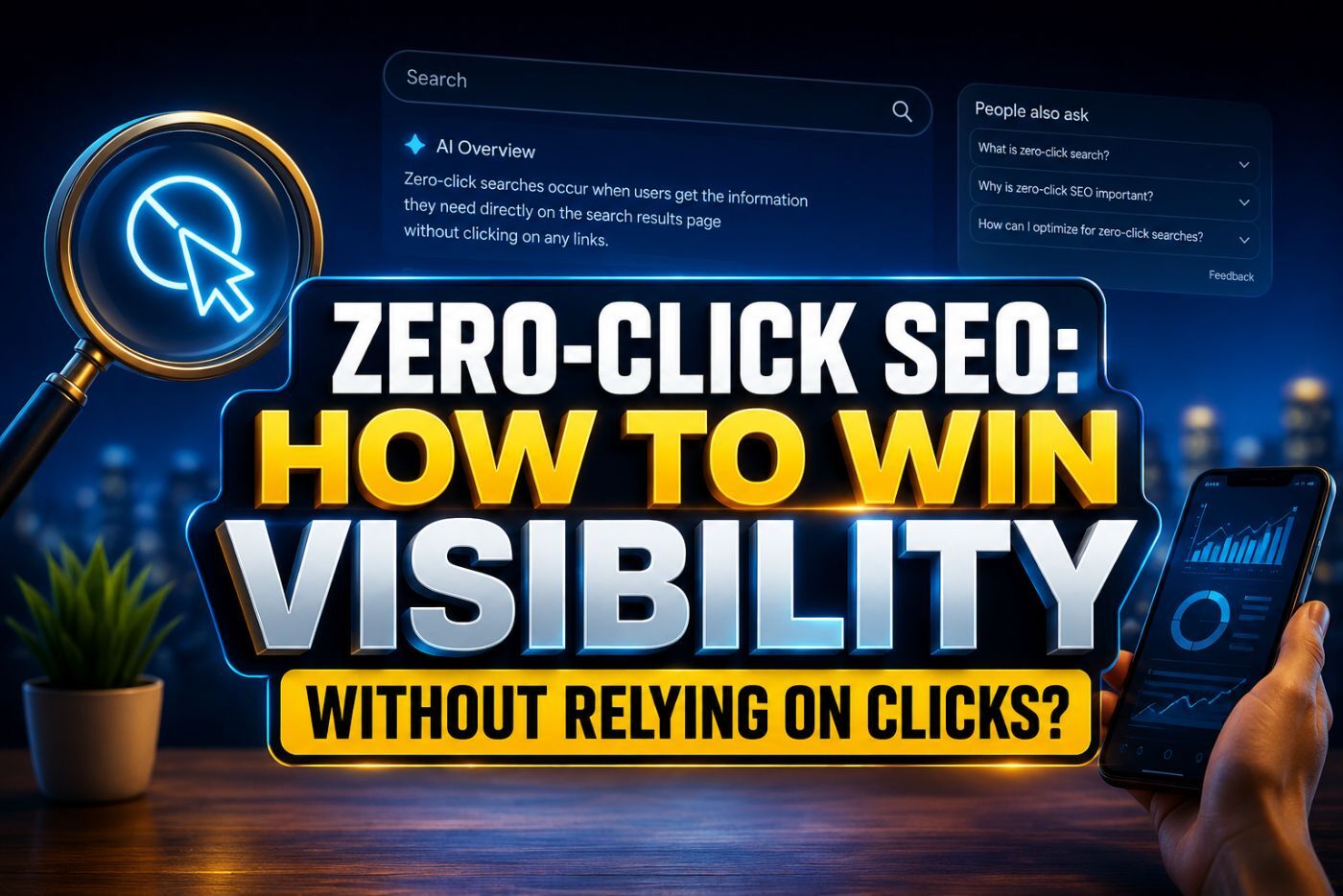
You search Google and right away at the top of the results page locate the solution in the main results section. You read the answer and then close your browser. The result is a zero click through. The searcher did not visit the website or click on any of the displayed links.
According to a recent study, approximately fifty-eight percent of the total number of queries performed on Google were simple searches that resulted in no clicks to a website.
This can be attributed, in part, to the emergence of AI Overviews and other similar services that are now populating the entire screen of search results for an increasing number of queries.
Because of this growth, the trend is expected to continue, meaning that if you are closely watching your organic traffic as your only measure of success, your view of the industry has drastically changed.
SEO isn’t dying. But zero-click SEO is where a lot of the real opportunity has moved, and most content teams haven’t caught up yet.
What Zero-Click SEO Actually Is
Most of us are interested to know how to get visibility in zero-click search results.
But first understand the concept. Zero-click SEO is a kind of search marketing that lets your material show up on a search engine results page (SERP) even if no user goes to your website.
That visibility shows up across several formats:
– Featured snippets: the answer boxes Google pulls to the very top of results
– AI Overviews: Google’s AI-generated summaries, which became mainstream in 2024
– People Also Ask boxes
– Knowledge panels
– Local packs (the map clusters you see for any “near me” type search)
None of these require a click to deliver value. Someone sees your brand name attached to the right answer, and something registers, even if they don’t visit your site that day.
It’s closer to organic brand awareness than traditional SEO. You’re not chasing a conversion. You’re building familiarity with the people most likely to eventually convert.
Why AI Has Made This Urgent
Google’s AI Overviews shifted things quite fast. Before 2024, zero-click real estate couldn’t go higher than a good featured snippet. For a large spectrum of questions, an AI-generated block now stands above everything, above advertisements, above blue links, above highlighted snippets. Users are provided with a consolidated response based on multiple sources before they have had time to discover the information through scrolling.
This pertains to what is known as AEO, which stands for Answer Engine Optimization, terminology that is commonly used in the field of SEO. The people are not only searching and getting their information on Google anymore, but they are now relying on artificial intelligence-based answer engines such as ChatGPT, Perplexity, Claude, among others.. Those systems don’t rank your website. They either reference your content or they don’t.
AI answers optimization (structuring content so AI systems can extract and attribute it) is probably the most underrated skill in search right now. The businesses that are taking it seriously now will have a meaningful head start twelve months from now.
The Mindset Thing Nobody Talks About
While most SEO content ignores the fact that this is important, zero-click SEO can only work if your content is written to fully respond to the user’s query, directly on the page. No teasing, no “to find out more, click here.” A lot of content teams resist this instinctively. There’s years of conditioning around holding the “real” answer back to drive clicks.
Worth pushing past that.
Google and AI systems have gotten extremely good at spotting thin answers designed to pull people in rather than actually help them. Content that dances around the answer to protect traffic tends not to earn featured placements. Content that answers a question directly, specifically and quickly is the content that gets surfaced.
When your content fully answers the user’s question, two things happen: some of the users will find the information they need without visiting your site, and many others will begin to associate your company with dependable, beneficial information.
The second effect compounds. The first one stings a little less when you realise that.
Six Things Worth Actually Doing
1. Start with the Answer, Not the Introduction
If someone searches what zero-click SEO is, your website ought to be ready to respond in two or three sentences. Google sources featured snippets from information answering quickly.
A working definition should appear as follows:
Zero-click SEO is the process of improving material for search engine visibility especially by means of featured snippets, AI Overviews, and other SERP visibility elements in cases when users get their answer without clicking through to a website.
Tight. Direct. No wind-up. That’s the format that gets extracted.
2. Your Subheads Should Be Phrased As Questions
Change your subhead Featured Snippet Review to What Is a Featured Snippet and How Is It Important? However, it also much more precisely represents how actual people search, therefore raising its possibilities of being highlighted. Should your H2 match a search query, the content below it may be a good candidate for the answer box above that same question. That’s worth a slightly awkward heading.
3. Paragraphs for Answers Should Be Short
Featured snippets’ responses range from 40 to 60 words. A 200-word paragraph will cause Google to be confused and therefore not even offer it as an option.
After your subheading, include just one paragraph of about two to three sentences that will give you the answer. This way, you can further elaborate on the topic later. The short paragraph near the top does the snippet work. Everything below it handles the nuance.
4. Add a Proper FAQ Section (With Schema)
FAQ sections are genuinely useful here, more so than most content types. They help with People Also Ask boxes, they give you multiple entry points into AI Overviews, and they’re naturally structured the way people actually search.
Some factors that can help make them more effective:
– Use the “People also ask” box to pull question ideas for your specific topic. You don’t have to guess at what people are asking; Google is doing all of the work for you.
– Every response ought to fit within 80 words or less. Not excessively short nor too long.
– All plain English all the time. When you use jargon, provide an explanation in the same sentence.
– Use schema markup for FAQPage. While Google can find your FAQ without it, it makes the search process much simpler for both you and the search engine.
There is only one action from this post that is absolutely critical.
5. Create the Type of Authority Sites AI Overviews Rely Upon
AI Overviews SEO is new enough that no one has a perfect playbook for it yet. However, certain patterns have become apparent. As a rule, AI overview searches on Google rely on information from sites with good ranking positions, strong backlinks, and thorough research on the matter, rather than narrow coverage of the topic.
What that suggests practically:
– Cover topics thoroughly, not just the obvious angle but the adjacent questions too
– Use proper heading and summary paragraphs, not long blocks of texts without structure.
– Remember, publishing three well-linked, thorough articles would exceed fifteen flimsy ones.
– Where appropriate, use structured markup: FAQPage, HowTo, Article.
No guarantees. But content written for human readability first, and machine parseability second, tends to show up in more places than content that tries to game one or the other.
6. Local and Visual Search Are Also Zero-Click Territory
Worth a mention, especially for businesses with physical locations.
Local pack results will offer your name, rating, hours, and contact number to users even before they get to your website. A local business page that isn’t updated with the latest information loses out on zero-click traffic. Updated photos, current descriptions, and responsive customer replies can help you here.
For online stores and other products-focused sites, image searches and shopping results are similar to local packs. Alt tags, proper filenames, and product schema all contribute to clickless visibility.
To further enrich your knowledge base, also, give this blog a read, “Topical Authority Map: How to Build SEO Content Clusters That Rank?”.
Measuring the Unmeasurable (Sort of)
The honest problem with zero-click search strategy is that most standard analytics don’t capture it. You can’t track impressions in the way you track sessions.
Zero-click success is partly a branding exercise. That’s not a cop-out. It’s a different return profile than a last-click conversion. Imagine it how you would a skillfully placed advertisement. Nobody clicks a billboard. But enough of the right people seeing it often enough does something.
Is All This Worth Prioritising?
Probably, yes. Depends on where you’re starting from.
Click-through traffic from organic search has been slowly declining as a percentage of all searches for several years now. AI tools appear to be accelerating that. Competing purely for clicks in that environment means fighting harder for a smaller share of something that’s already shrinking.
Zero-click visibility through featured snippets, People Also Ask, AI Overviews, and the rest of the SERP real estate is one of the more durable bets available in search right now. You’re building recognition and authority that tends to survive algorithm updates better than traffic-first tactics do.
The places to start are also the least complicated: FAQ sections on key pages, intro paragraphs that lead with answers, and a regular check on which queries in Search Console are generating impressions without clicks. That last one often surfaces more opportunity than people expect.
That’s not a loss if your response appears near the top of a Google search and someone reads it, shuts the tab, then moves on.That’s your content doing its job in the format search now expects.


 +971 582 871635
 +971 582 871635