


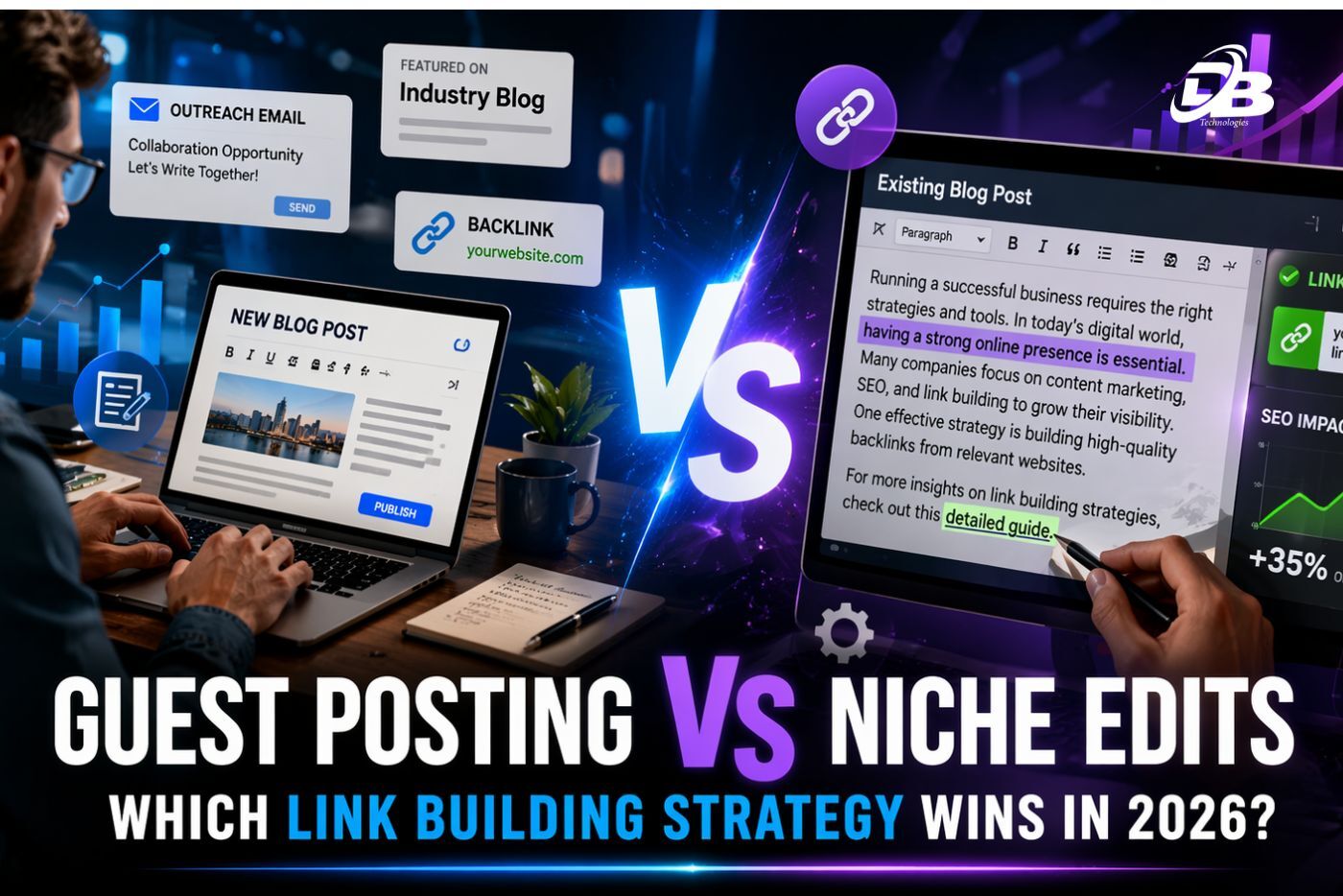
Spend like 5 mins in any SEO group and this debate just pops up again and again. Guest posting vs niche edits — which one actually helps rankings move? You’ll see people on both sides defending their method like crazy and kinda brushing off the other one. And tbh… both of them aren’t completely wrong, it just depends I guess.
The argument about guest posting vs niche edits has been going on for years.
What’s really changed is everything around it tbh. Google is way more smarter now, like it actually understands stuff better, plus the standards for links are higher than before. And honestly the difference between a properly done campaign and just a lazy one? it’s huge now… very obvious.
So instead of just asking “which one is better” in 2026, the real thing is — better for what exactly you’re trying to achieve right now.
This guide breaks down everything – the mechanics, trade-offs, cost comparisons, and when to use each.
Let’s Define the Two Properly
Guest Posting
You write an original article from scratch and publish it on someone else’s website. In return, you get a backlink, usually inside the body of the content or sometimes in an author bio. The whole arrangement works because the host site gets fresh content and you get editorial exposure and a link from a real, relevant domain.
A solid guest posting SEO strategy has always been about more than just the link. It has brand visibility, byline authority, referral traffic, and relationships with editors who may invite you back. When done well, a guest post on the right site can draw traffic for years.
Niche Edits
Niche edits – sometimes called link insertions – work differently. Instead of creating new content, you get an article that’s already published, already indexed, and already ranking, and you put your link in there.No writing required. You’re essentially buying a spot inside content that Google already trusts.
The appeal is obvious. Niche edits backlinks inherit the authority the page has already built. A three-year-old article sitting on page one for a competitive keyword has done years of earning trust — and now your link gets to benefit from that.
When people start arguing about link insertion vs guest posts, it almost always comes down to the same thing… speed and quick wins on one side, and then brand value + fresh content on the other.
The Case for Guest Posting in 2026
Matt Cutts declared guest posting dead in 2014. SEOs panicked, wrote long posts about it, and then… kept doing it. Because it works.
So, does guest posting still work in 2026 ? Answer is yes, even better than before.
What you actually get from a guest post
The link is the headline benefit, but it’s not the whole story. Guest posting is one of the few white hat link building strategies that also builds something beyond SEO metrics:
- Your name appears on a respected site in your niche — that means something to readers and to Google’s E-E-A-T signals
- You control the anchor text because you’re writing the content, which matters when you’re targeting specific keywords
- Referral traffic from a genuinely well-read publication can outlast any algorithm update
- Editorial relationships compound — one accepted pitch often leads to another
None of that comes from a link insertion. That’s not a knock on niche edits; they just serve a different purpose.
Where guest posting gets difficult
Turnaround time is the main friction point. From the initial pitch to a live link, you’re realistically looking at three to six weeks — and that’s if the editor responds quickly. Many don’t.
Quality expectations have also shifted upward. A generic 700-word post with a thin opinion and a few headers won’t cut it on any site worth publishing on. The editors managing those sites are flooded with identical pitches. What gets through is either a genuinely useful piece of writing or a relationship-driven placement — ideally both.
The sites worth getting links from are exactly the sites that are hardest to get into. That friction is part of what makes the link valuable.
The Case for Niche Edits
Niche edits don’t get as much attention in SEO content as guest posting does, but among practitioners who’ve tested both, they’re often the preferred option for building links at pace.
Why established content passes value faster
When you publish a guest post, that page starts from zero. It needs to be crawled, indexed, and then slowly accumulate its own authority before the link pointing to you starts doing much. Depending on the domain, that can take months.
A guest posting vs niche edits SEO comparison almost always highlights this timing gap. With a niche edit, the content is already years into its life. The page has backlinks, it has traffic history, it probably ranks for several terms. Insert your link there and the equity transfer happens much sooner.
That’s the core argument for niche edits backlinks — you’re not waiting for a new page to earn credibility. You’re tapping into credibility that already exists.
Are niche edits safe for SEO?
This is a fair question and it comes up every time someone new to this strategy encounters it. Answer: Yes, when the execution is clean
The risk isn’t in the method — it’s in the shortcuts. A link placed naturally inside a real, well-written article on a legitimate site that gets actual organic traffic? Google has no particular reason to flag that. Are niche edits safe for SEO in that context? Almost certainly.
What causes problems is buying bulk placements from link networks, inserting links into content that has nothing to do with your niche, or working with sites that exist purely to sell links with no real readership behind them. Those risks apply equally to guest posting done badly, by the way.
Which Is Better: Guest Posting or Niche Edits?
The straight answer to which is better guest posting or niche edits is that it depends on what you’re optimizing for right now.
If you’re a newer site trying to establish authority in a competitive niche, guest posting probably deserves more of your attention. The brand signals, the byline exposure, the editorial relationships — those things matter more at that stage than sheer link volume.
If you’ve already got some authority built and you’re trying to push rankings on specific pages without spinning up a full content operation, niche edits are usually the more efficient path. Less time, lower cost per link, and faster equity transfer from pages that already rank.
In practice, the best link building method 2026 almost never isolates one or the other. Most effective campaigns use guest posting for authority-building and brand presence, and specific editing to fill link gaps faster and more cost-effectively. They complement each other well.
Ten high-quality, contextually relevant backlinks will consistently outperform a hundred average backlinks.And this applies on both.
Practical Tips That Actually Help
General advice about “choosing quality sites” only goes so far. Here’s what makes a real difference in practice:
For guest posting
Research before you pitch. Read several articles on the site before reaching out. Reference something specific in your pitch — a topic they haven’t covered, a counterpoint to something they published. Editors can tell immediately whether you’ve actually read them.
Make the content earn its place. The post needs to be useful to their audience, not just a container for your link. If the content is good, the link gets accepted. If the content is thin, no amount of relationship-building fixes it.
Traffic over DR. A site with a DR of 45 and 12,000 monthly organic visitors is worth more to you than one with a few hundred DR of 70. Check traffic estimates before pitching.
Don’t over-optimize anchors. One exact-match anchor per campaign target, maximum. The rest should be branded, partial match, or natural phrase variants. Stacking identical anchors is the quickest way to trigger a manual review.
For niche edits
The page matters more than the domain. A strong domain with a dead page gives you very little. Find articles that are actively ranking and generating organic impressions — that’s the signal that link equity is flowing through that URL.
Context has to make sense. If your link lands in a sentence where it feels out of place, it’s a bad placement. A reader (or a Googler) stumbling on a link that seems randomly inserted is a yellow flag. The surrounding sentences should make the link feel like a natural reference.
Vet the seller carefully. There’s a lot of low-quality inventory in the niche edit space. Look for sellers who can show you traffic data for the specific pages, not just domain-level stats. And be sceptical of anything priced suspiciously low.
Mix it with guest posting. A link profile that’s entirely niche edits looks different to one that includes editorial guest posts and natural mentions. Diversity is healthy, and Google’s crawlers are pattern-aware.
The 2026 Context: Why Standards Have Gone Up
It’s worth addressing what’s actually changed, because the niche edits vs guest posts SEO conversation looks a bit different now than it did three or four years ago.
Google’s helpful content updates have gradually devalued pages that exist primarily for SEO purposes — thin guest post placeholders, low-effort link host sites, content farms. That affects both strategies. Sites that used to accept and pass link equity freely now get less value from Google if their content quality is poor.
For white hat link building strategies like these to stay effective, the underlying content quality has to hold up. A guest post on a site with strong editorial standards is worth considerably more than the same post on a site that’ll publish anything. The same logic applies to niche edits — the host page needs to be real content that real people read.
E-E-A-T — which is Google’s way of looking at Experience, Expertise, Authoritativeness and Trust (yeah, that whole thing) — has kind of made things more obvious now. Like, if a link is coming from a site that clearly knows what it’s talking about, it just hits different compared to some random blog that doesn’t even have a proper voice or audience.
This isn’t really some new concept or anything tbh, it’s been around for a while… just that now the importance of it has kinda changed over time.
So yeah, the actual question now is — what type of backlinks are even working in 2026 anymore?The ones that sit inside content a real human being would actually want to read. Everything else is just hoping the algorithm hasn’t caught up yet.
So, Which One Wins?
Neither, on its own. That’s the honest answer to the guest posting vs niche edits question.
Guest posting is slower, harder to scale, and demands real content effort. But it builds something niche edits can’t: brand authority, editorial credibility, and a footprint that signals expertise over time. For a site trying to establish itself in a competitive space, those things matter.
Niche edits are faster, generally cheaper, and pull link equity from content that’s already done the hard work of ranking. For campaigns that need to move quickly or fill link gaps without a full content operation behind them, they’re often the smarter choice.
The best link building method 2026 is a combination — guest posting for the long game, niche edits for efficiency. Use both with real quality standards, and the results become complex in ways that neither method can achieve alone.
Pick the right tool for the moment.. Vet everything. And remember that Google’s gotten very good at recognising when a link exists to help a reader versus when it exists to game a ranking.




 +971 582 871635
 +971 582 871635