


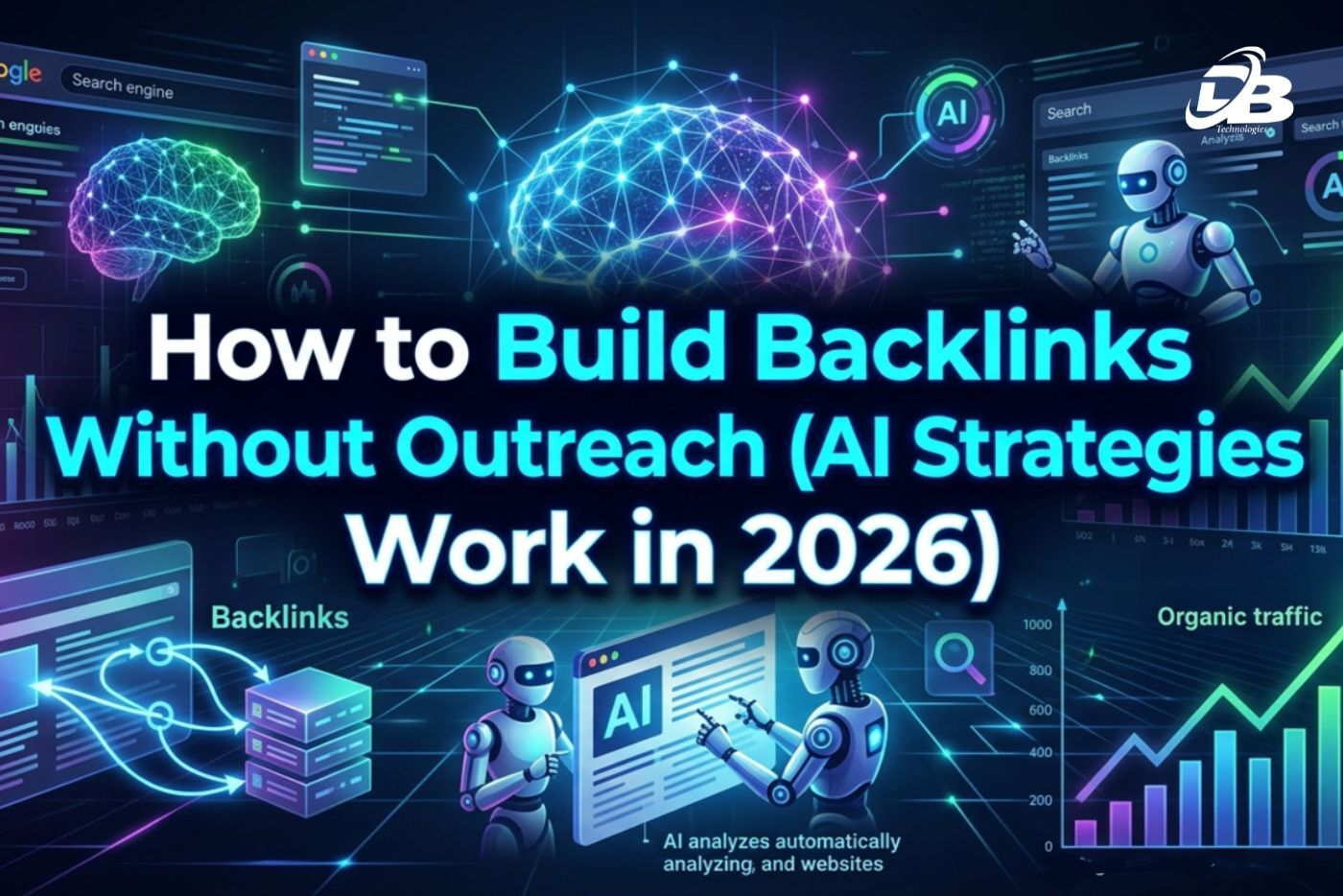
Let me start with something a lot of SEOs won’t admit — link building outreach is kind of demoralizing.
You spend a good chunk of your week writing what feels like a genuinely thoughtful cold email. You personalize it. You tweak the subject line. You hit send on maybe 40 or 50 versions of the thing. And then… mostly nothing. A couple of auto-replies, maybe one real response, and that response is usually asking for money.
So, can you actually build backlinks without outreach?
In 2026, with AI tools genuinely changing how content gets researched and produced, the passive route has become more viable than it’s ever been.
That’s what this is about. Passive link building, AI-assisted content strategies, and the kind of approaches that appear to make other websites want to link to you without anyone having to ask.
So What Is Passive Link Building?
Passive link building, at its core, is about setting things up so links come to you rather than the other way around. A useful way to think about it, hunting versus farming. One demands constant effort. The other requires real work upfront, but keeps producing over time.
“Passive” doesn’t mean you disappear and wait. There’s a setup phase, and that phase matters a lot. But once the right content is out there and indexed, it tends to do its own thing. People find it, reference it, share it and you end up with backlinks you didn’t have to chase.
What’s changed recently is that AI link building strategies have started to genuinely close the gap. Not by flooding the internet with thin content — that’s a bad idea and it’s getting worse as an idea — but by helping people identify what kind of content tends to earn links, and then build it faster.
Why Outreach Probably Isn’t the Only Way
There’s a fairly common assumption in SEO circles that if you’re not actively doing backlinks without outreach, you’re not really doing link building. That supposition appears to be more and more obsolete.
The number of materials being published on a daily basis is astounding. Journalists, editors and bloggers always seek sources that they can cite.
If your content is that source, if it’s well-researched, clearly structured, and easier to reference than what’s already ranking, links do tend to follow.
Not necessarily swiftly, or in a straight line, but they follow.
It is also worth mentioning that, over the years, Google has indicated that the weight of earned backlinks outweighs the weight of those that are obtained via link schemes. Which is why there is an argument of quality here, as well as a comfort argument.
Passive and AI-driven link building strategies appear to produce better quality links in many cases, partly because the people linking chose to do it on their own. No one nudged them. That tends to matter.
Strategy 1: Build Linkable Assets Around Real Problems
The foundation of earning backlinks organically — probably the clearest one — is creating something genuinely difficult to find elsewhere.
What does that look like? There are several things, which crop up now and then:
– Original work or data – a survey, an industry report or an analysis that you performed using your own data or publicly available sources.
– An actually comprehensive guide, not a listicle of shallow nuggets, but something that would respond to the question comprehensively.
– Free tools or calculators — even basic ones tend to attract consistent citations
– Curated databases or comparison pages — the kind of thing journalists reach for when they need a quick reference
These are what people usually call linkable assets. The logic is fairly straightforward: when someone’s writing an article and needs to cite something, they’ll link to the best resource they can find. If that’s you, they link to you.
AI can help identify where those gaps actually are in your niche — what’s being searched that hasn’t been answered well, what data your industry is missing. Finding the gap is sometimes half the work.
Strategy 2: Use AI to Build Topical Authority (Slowly and Properly)
A less-appreciated passive link building tactic currently is to develop topical authority by creating a content cluster – and applying AI to assist in mapping that cluster out first, then commence writing.
The idea is to choose a topic, do research and create a well informed web content around it, get it published.
A main pillar page, then a set of supporting articles that all connect to each other. Done well, it can position your site as a credible resource on that topic — not just for Google, but for the humans who end up linking to you.
Whenever a researcher or journalist is in search of authoritative sources, they are likely to refer to websites that are well aware of what they are talking about. A site that has 20 intelligent articles on, say, remote hiring practices, will tend to get more organic backlinks than a site that wrote one good article, and then left to write about something different.
AI tools are able to assist you map the cluster, uncover which angles are currently filled and which ones are not, and develop a publishing plan that does not disperse your effort. The writing remains in real time- there is no short cut to it- but the research and planning can be condensed to a large extent.
Strategy 3: Get Listed in Industry Resources (This One’s Underused)
There’s a semi-passive strategy that I don’t see talked about nearly enough: getting your site, tool, or content listed in curated industry resource pages.
Every niche has them. Directories, recommended reading lists, curated link collections, these pages link out to dozens of sites and tend to stay up for a long time. If you can get added to a handful of relevant ones, those links stick around.
AI helps with the discovery side here. Instead of spending hours manually hunting for relevant resource pages, you can use it to generate a list of the types of pages that exist in your niche, or help you search more efficiently.
And yes, submitting to a resource page does involve some contact with another human. But it’s a different category than cold outreach. You’re not asking someone to link to your article as a favor. You’re suggesting a relevant, useful resource for a list that was explicitly built to include things like it. The intent is completely different, and the response rate tends to reflect that.
Strategy 4: Publication of Data that can be used by Journalists
When the objective is to attract backlinks naturally, one of the most dependable methods of content-based backlinks is to publish information which reporters require whenever they are writing on your subject.
Consider how frequently you encountered a recent study in an article with a hyperlink attached afterwards. That link didn’t come from outreach. Somebody published something findable and useful, and a journalist found it through search. That’s the whole play.
A rough version of how this works in practice:
1. Run a survey — even 150 to 200 responses can be enough for niche topics
2. Publish the results with clean charts and stat callouts that are easy to quote
3. Optimize the page for terms like “[your industry] statistics 2026”
4. Let journalists find it when they’re covering your topic
AI can make the process faster — helping design survey questions, structure the report, or identify which stats are most likely to be cited. Something that used to take several weeks can reasonably be done in a few days.
Strategy 5: Free Tools Get Linked to Constantly
Possibly the single most reliable passive link building asset you can create is a free tool. Not a complex one. Just something useful that people in your niche actually reach for.
A meta description length checker. A simple budget calculator. A readability scorer. A free template. These things get linked from blog posts, newsletters, YouTube descriptions, Reddit threads — often for years after the original publish date.
The insight here is that the tool doesn’t have to be impressive. It just has to solve a specific, real problem.
In this new age AI era, building something like that is accessible. AI coding tools have lowered the barrier enough that a basic functional tool can be built without a development background — describe what you need, get working code, have someone review it, publish over a weekend. It’s not guaranteed to go well, but it’s worth trying.
Strategy 6: Podcast Appearances Are an Overlooked Link Source
Here’s a passive link building angle that tends to fly under the radar: podcast show notes.
When you appear on a podcast as a guest, the host almost always publishes a page with show notes. That page includes links — to your site, your social profiles, any resources you mentioned. If you do five or ten podcast appearances over a year, that’s five or ten backlinks from topic-relevant sites, with no link request involved.
There is some outreach in pitching yourself as a guest. But the dynamic is different — you’re not asking for a link, you’re offering to be useful to someone’s audience. The link is just what naturally happens when they publish the episode page.
AI tools can help you find which podcasts in your niche accept guest pitches, what their recent topics have been, and what kind of angle might genuinely fit their format. That research — which used to take hours — can be done in minutes.
Strategy 7: Be the Person Journalists Quote
The first mainstream form of this was most likely HARO, Help a Reporter Out. It has evolved to a different platform, yet the concept behind it is more timely than ever.
Journalists and content creators often make requests to expert sources on certain topics. If you respond to those requests with something genuinely useful and specific — not vague, not hedged into meaninglessness — you get cited. And cited typically means linked.
The passive part kicks in once you’ve done this a few times and built a small track record. At some point, reporters start reaching out directly without you having to monitor any platform. Your inbox becomes a link source on its own.
AI can help in the prep stage — structuring your response to a media query, making sure it’s concise and quotable, keeping it from drifting into the kind of vague corporate-speak that gets ignored.
Strategy 8: Content Repurposing as a Link Funnel
Most people understand content repurposing as a distribution tactic. In 2026, fewer think of it as a passive link building strategy — which it can be, if it’s set up right.
Here’s the rough flow. You write a thorough article. Then:
– Turn key sections into a LinkedIn post or X thread, linking back to the full piece
– Adapt the core into a Medium or Substack post with the original article linked
– Build an infographic version for Pinterest or visual search
– Record a short explainer video for YouTube, with your article in the description
Each of these formats can generate backlinks to the original. The Medium post links back. The YouTube description links back. Someone who finds the infographic and wants the full context links back. It compounds in a way that a single published article usually doesn’t.
AI tools can help with the adaptation work — turning an article into a social thread or a short-form piece fairly quickly. The output always needs editing (that part doesn’t change), but it removes a lot of the friction from repurposing consistently.
We also invite you to read this blog, titled, “SaaS Link Building in 2026: How to Build Authority Backlinks That Rank.”
A Note on AI-Generated Content and Link Building
Worth addressing directly: there’s a version of “AI link building strategies” that involves publishing hundreds of thin, auto-generated articles in hopes that sheer volume produces links. It appears to work in the short term, sometimes. It tends to fall apart.
What actually seems to work is using AI content for backlinks, that’s genuinely better than what already exists — faster, but not at the cost of quality. More research, better structure, proper editing. It is not quantity of content, but quality.
AI can assist in good faith with: filling in holes in the current materials, creating sound first-drafts, which you then overwrite extensively, making sense of what is ranking and why, and making the distribution side quicker. The human element — your actual expertise, your specific take, your original data — is still what makes content worth linking to. AI speeds up the surrounding process.
A Rough Framework for Getting Started
If you want to actually do this and not just think about it, here’s a simple place to start:
First month: Identify two or three linkable asset ideas that actually fit your niche. One of them could be a guidebook, one a piece of original data, one a mere instrument. Explore existing knowledge with the help of AI and identify the gaps.
Second month: Build and publish your first asset. You can move at your own pace with it- it is not a volume game. Advertise it within the respective communities (forums, subreddits, LinkedIn groups in your niche) to achieve first momentum and feedback.
Third month: Start mapping a topical authority cluster. Outline eight to ten supporting articles around your main topic, use AI to help with the research and drafting, and publish two or three pieces. Edit everything yourself.
Ongoing: Keep publishing within the cluster, track which content is earning links through Google Search Console, and focus more effort on whatever’s working.
It’s not a fast strategy. Passive link building strategies 2026, compounds slowly. A piece of content you publish this month might still be picking up links two or three years from now — which is either frustrating or encouraging, depending on how you look at it.
Final Thoughts
The question of how to get backlinks without outreach used to feel a bit naive — like it assumed the rules didn’t apply to you. But the reality has shifted in a meaningful way.
Content-driven backlinks, topical authority, original data, free tools — these aren’t workarounds. They’re arguably the most sustainable form of link building there is, because the links you earn this way reflect actual usefulness rather than persuasion skill.
Outreach can still have a place in a broader strategy. However, it does not necessarily have to be the engine. Create something really worth mentioning, bring it to the right people, and the links will grow by themselves at their own time.




 +971 582 871635
 +971 582 871635