

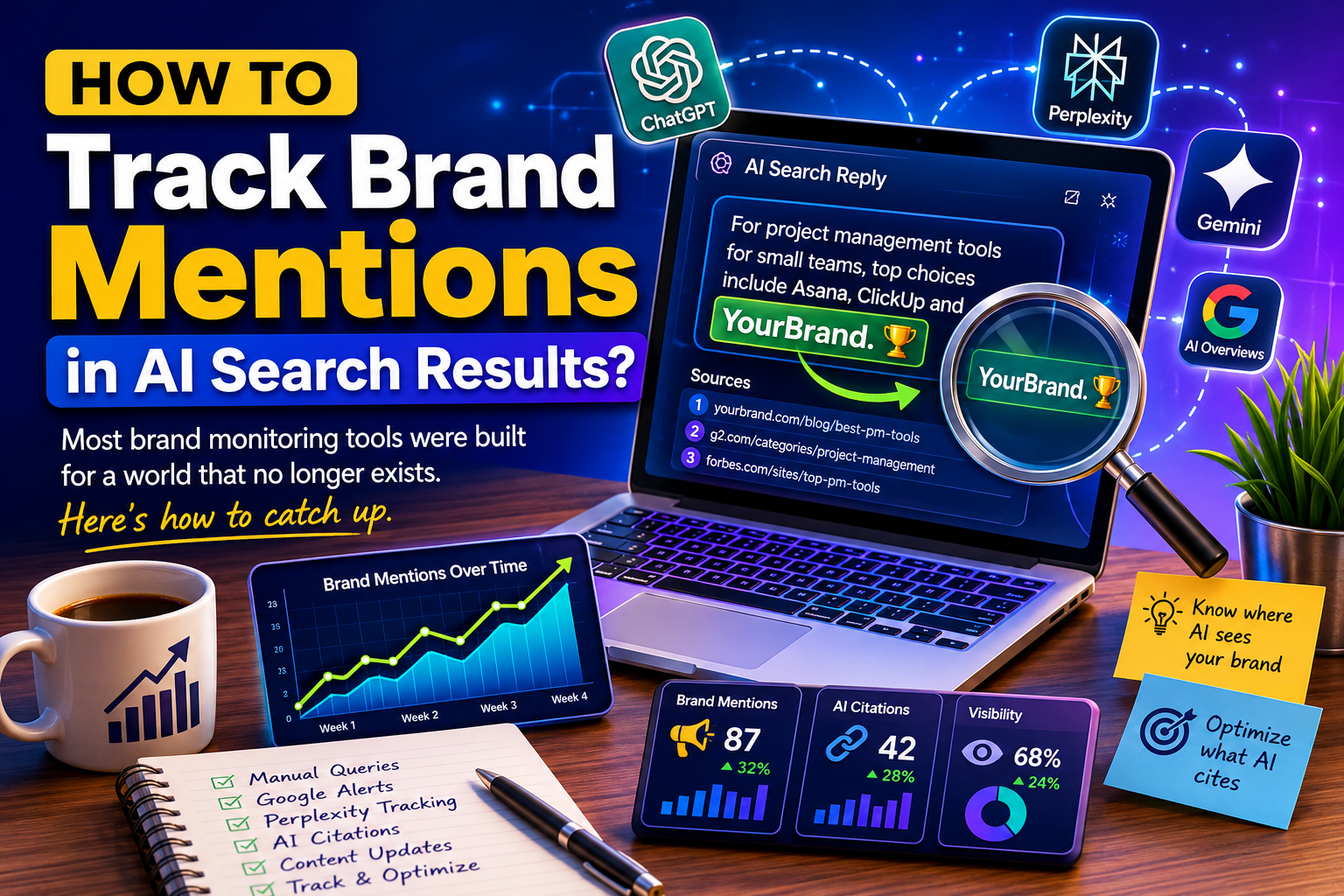
Most brand monitoring tools were built for a world that no longer exists.
Here’s how to catch up.
You search your brand on Google. You scan Twitter mentions. There’s probably a Google Alert from 2019 still forwarding emails you barely open. For years, that setup was enough.
It may not be anymore.
The fraction of potential buyers who bypass search results altogether is ever increasing.
Customers who, rather than navigating through a list of blue links, will instead pose their question in ChatGPT, Perplexity, Gemini, and will accept what comes.
The presence and representation of your brand within these results will quietly influence decisions before you’re even in the market.
The frustrating part is that there is no “AI mentions” dashboard waiting for you in Google Search Console.
The platforms generating these answers tend not to share that data. So AI search brand tracking, for now, requires building your own system from a mix of manual checks, proxy signals, and a small but growing set of tools worth knowing about.
Why AI Search Brand Tracking Matters Right Now
Numbers first. According to a 2024 SparkToro and Datos study, zero-click searches appear to account for more than 58% of US searches.
AI Overviews in Google, alongside standalone tools like Perplexity and ChatGPT, seem likely to push that figure higher still, though how quickly remains genuinely unclear.
What it means in practice is more concrete. Someone types “best project management software for small teams” into Perplexity. A response comes back naming two or three tools.
If yours isn’t among them, that query effectively went to a competitor. You’d have no way of knowing it happened.
That’s the core problem AI citation tracking is trying to solve. It isn’t really about vanity metrics or brand awareness in the abstract.
The process involves determining the data sources for AI models, assessing if your content is included in those sources, and making necessary adjustments if it is not.
Step 1: Start with Manual Spot-Checks
At first open any AI chat bot. Run the kinds of questions your actual customers are likely asking:
So that’s about where the AIs are learning from; whether you are in that pool; what you can change, if you aren’t.
- What is a good [category] tool for [use case]?
- Who are the industry leader at present?
- What do you know about [competitor name], are there alternatives?
Look to see if you are mentioned, how your brand is described, and which sources are listed.
Perplexity tends to be the most useful for this because it shows its citations alongside the answer. You can click through directly to see which pages it’s pulling from.
Once a week is a reasonable cadence. It’s slow. There isn’t quite a plug-in replacement for that still. But the benefit to forming that habit is that you establish a benchmark and you can’t see trends without a benchmark.
Step 2: Use Google Alerts as Your Proxy Signal
Google Alerts won’t tell you when ChatGPT mentions your brand directly. What it can do is catch the articles and roundups that AI tools tend to draw citations from.
Set up alerts for:
- Your brand name
- “[Your brand] review”
- “[Your brand] vs [competitor]”
- “[Your brand] alternative”
The connection to AI mention tracking is indirect but real. AI models retrieve heavily from published web content. A comparison article that ranks well in traditional search is often the same page appearing as a citation in Perplexity or an AI Overview.
Monitoring what gets written about you, even through a relatively blunt tool like Alerts, can surface content that’s quietly influencing what AI tools say about your brand.
Step 3: Create a Perplexity SEO Monitoring Process
Of all of the main AI search engines Perplexity is the most transparent regarding its sources.
That transparency makes it particularly useful for anyone trying to monitor brand mentions in AI answers.
Each Perplexity response includes numbered citations displayed alongside the text. Those citations are your visibility window. Simple weekly structure will be:
– Prepare a few questions that your customers are most likely to ask.
– Run each one in Perplexity’s web search mode.
– Record whether your domain appears in the citations, and at what position.
– Log it: date, query, citation position, and the specific URL cited.
Four weeks of this is usually enough to start seeing patterns. Which pages get pulled consistently? Which query types tend to surface competitors instead of you? Where is the gap widest? Those answers tell you where to focus your content effort next.
Step 4: Tools Worth Knowing About for AI Mention Tracking
The tooling landscape for AI mention tracking is early and still developing. Most options involve trade-offs worth understanding before committing to one.
Brandwatch and Mention both track web and social coverage and are beginning to index AI-generated content in limited ways. Neither yet offers a clean view of “ChatGPT brand visibility” as a standalone metric, but they do catch secondary coverage that tends to feed into AI citation pools.
SE Ranking and Semrush have started adding AI Overview tracking inside their existing rank monitoring interfaces. If you’re already using one of these platforms, it’s worth checking whether it now flags when AI Overviews appear for your target queries and whether your content appears inside them.
Query scraping is a more technical approach, but worth mentioning. Some developers have built lightweight scripts using the Perplexity API or browser automation tools to run queries automatically and log results over time.
If you have someone technical available, this can produce surprisingly useful monitoring at relatively low cost. The limitation is that ChatGPT and Gemini are considerably harder to scrape reliably due to how their interfaces handle sessions.
ChatGPT brand visibility presents its own challenges. Responses in ChatGPT can vary based on conversation context, model version, and user location in ways that make consistent tracking difficult.
That said, ChatGPT Search has been surfacing web citations more consistently. Running your core brand queries there with web browsing enabled, and noting which pages get linked, is at minimum worth doing as part of your monthly check.
Step 5: Work on the Content AI Actually Cites
Tracking what’s happening is useful. Changing what’s happening requires a different kind of work.
AI tools don’t generate their answers from nothing. They draw from content that already exists and that they can retrieve. The pages that are generated to appear as citations appear to have some common characteristics, but, again, the mechanics of how AI retrieves pages is not fully understood, and what works can change.
AI citation tracking works better on pages which directly answer one specific question, and do so in the first hundred words, than pages that try to cover too much ground. Perplexity in particular seems to favour content where the answer is easy to extract without reading the whole page.
Backlinks still matter. A page linked to by several credible publications is more likely to be treated as a trustworthy source by AI retrieval systems than one that isn’t, even if the content itself is good.
Natural language that mirrors how people ask questions tends to do better than content written around keyword density. The relevant test is whether your content directly answers the kind of sentence someone would type into an AI chat window.
Freshness also appears to be a factor. Content that hasn’t been updated in a few years may drop out of AI answers faster than it would fall out of traditional search rankings.
Step 6: Track It All in a Simple Spreadsheet
You don’t need expensive software to get started. A Google Sheet with the right columns can carry you a long way. You can start compiling data is a sheet , like Date, Query, AI tool , Brand mentioned, citation positioned, URL cited, and competitor cited etc.
Run your seed queries once a week across two or three tools. Fill it in. In a month, the data has started to speak to you, you’ll find the patterns, see where there are holes and have a more concrete idea of which pages to target first.
Step 7: Notice how your brand is portrayed.
This step tends to get skipped. Getting mentioned in an AI answer is one thing. Getting mentioned accurately is another.
AI tools sometimes describe brands incorrectly. They cite outdated pricing, reference features that no longer exist, or slot companies into categories they’ve moved away from.
If Perplexity is describing you as “a tool for solo freelancers” and you’ve spent two years repositioning for enterprise clients, that description may be doing quiet damage before a prospect ever reaches your website.
As you run through the spot-checks yourself, concentrate not just on your name being present, but also on the wording in proximity to your name. Bad descriptions tend to be the result of old, confusing information on your site.
Updating your About page, core product pages, and any public documentation that AI tools are likely to crawl tends to be the most direct fix available.
Also read our blog about, “Schema Markup for AI Search: Structured Data That Helps Engines Understand You.”
The Honest Caveat
There is no perfect system for AI search brand tracking yet. The platforms themselves don’t share the kind of data that would make this straightforward, and the tools built to work around that limitation are still catching up.
What exists right now is a combination of manual checking, proxy signals, and a growing set of third-party features that are improving, though unevenly.
The clearest advantage available to anyone doing this today isn’t access to better tools. It’s a habit. Marketers who have been running queries, keeping records, and adjusting their content over the past several months will understand their AI citation footprint far better than those starting from scratch six months from now.
Start with the manual routine. Build the spreadsheet. Layer in tools as they mature.
Quick Recap
– Run weekly manual queries on ChatGPT, Perplexity, and Gemini using real customer questions
– Set up Google Alerts to catch coverage that feeds into AI citation pools
– Log Perplexity citations in a spreadsheet and watch for patterns over time
– Check whether SE Ranking or Semrush now tracks AI Overview appearances for your key queries
– Update priority pages to answer specific questions directly, not broadly
– When you monitor brand in AI answers, note the description, not just the presence
AI search isn’t erasing traditional SEO. What it does appear to be doing is adding a layer of discovery that existing monitoring tools weren’t built to see. The earlier you start paying attention to it, the more clearly you’ll understand what your brand looks like to the people asking AI tools for recommendations in your category.



 +971 582 871635
 +971 582 871635