

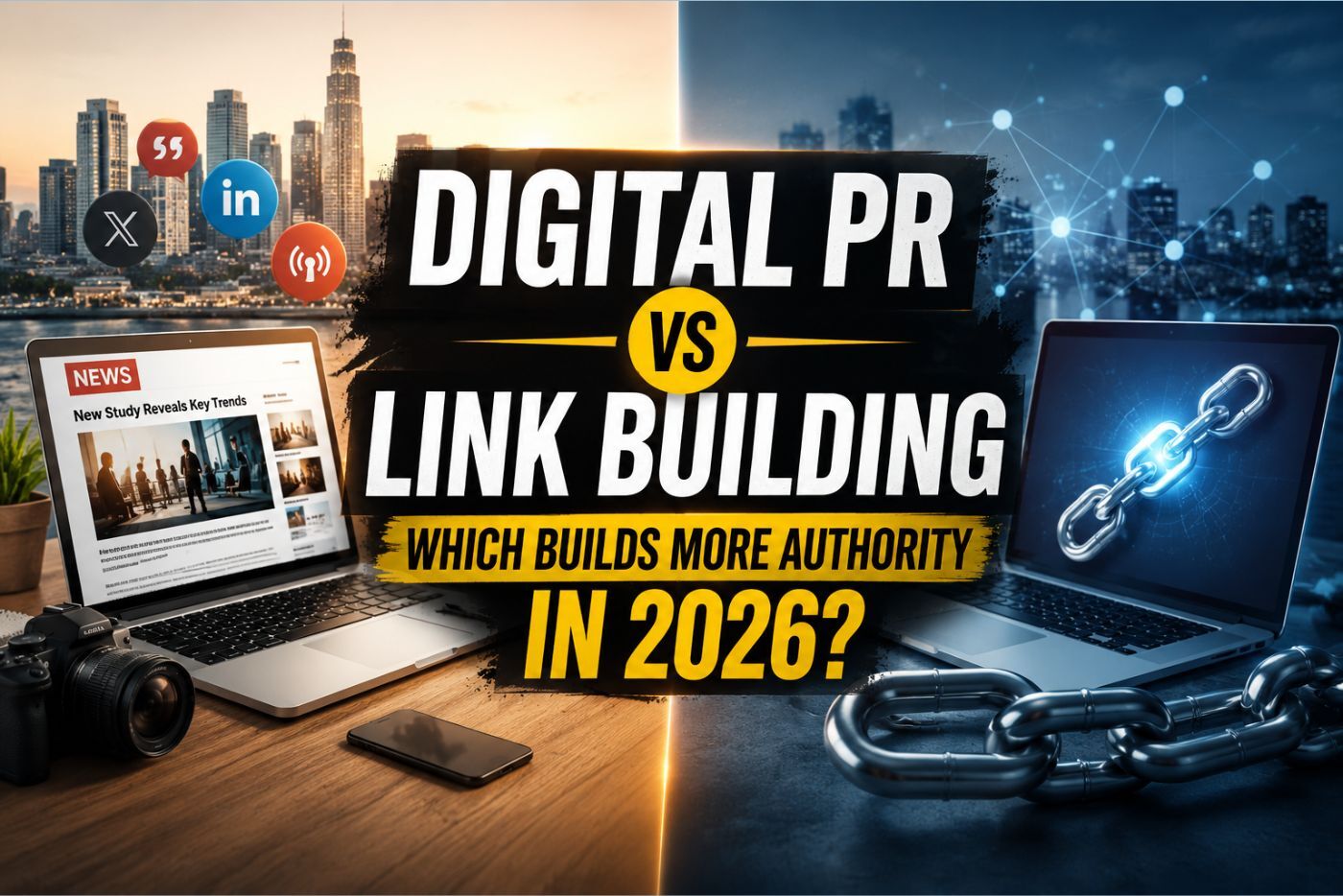
This is a matter of debate. In a world of SEO and inbound marketing, is digital PR the new link building or is outreach the foundation of any serious SEO campaign?
The honest answer, at least in 2026, is that the gap between these two approaches appears to be narrowing, though maybe not in the way most people expect. And if you’ve been running both in parallel without a clear sense of which one is actually doing more for your authority, you’re not alone. Most SEO teams I’ve spoken to are in exactly that position.
So let’s get into it.
What Actually Is Digital PR?
Digital PR is fundamentally about getting your brand, data or your expert opinion included in an online publication, whether that’s a trade mag, industry blog or news site. A journalist or editor is convinced that your content is worth reporting and writes about it, in the process connecting back to you.
The word that’s important is earned. You’re not paying for placement. You’re earning it by being useful, interesting, or timely, sometimes all three at once.
Here’s a simple example. You have written a survey about the trends of hiring remotely for your company. A tech-related site reads it, and does a small article and puts a backlink in your site from a DR 80+ domain. Digital PR is doing its job right. Whether it happens consistently is a different question.
And Link Building- Hasn’t That Always Just Been… a Thing?
Yes. Since basically the beginning of SEO, link building has meant convincing other websites to point to yours. The methods have changed, but the idea hasn’t.
In practice, it tends to include things like guest posting on relevant blogs, fixing broken links and swapping in your own content, building out resource pages, running outreach campaigns for editorial mentions, and — still, despite everything — buying links on certain corners of the internet.
What separates link building from digital PR is mostly the mechanism. Link building is usually more deliberate and more transactional. You approach someone, you offer something in exchange (content, exposure, whatever), and you get a link. Digital PR is closer to creating something people would link to regardless of whether you ask.
Both technically fall under the “link building” umbrella if you’re being broad about definitions. But the quality of what you end up with can be very different.
Why Does This Distinction Actually Matter Right Now?
Central to this debate is something that’s shifted noticeably over the past few years: Google’s ability to distinguish between a genuinely earned editorial backlink and one that’s been manufactured. It’s gotten much better at this. A link that appears because a journalist found your research useful carries, in most cases, meaningfully more weight than a link buried in paragraph four of a guest post that reads like it was written in an afternoon.
And then there’s the AI search angle, which is where this conversation gets interesting. If you care about AI citation authority or brand mentions for AI search and increasingly you should, digital PR appears to have a natural edge. Platforms like ChatGPT, Perplexity, and similar tools tend to reference brands that have a documented presence across credible publications. They’re doing something similar to what Google has always attempted, just with different signals and at different speeds.
Brand mentions are part of this too. An unlinked mention of your company in a respected industry publication still seems to contribute to how search engines and AI systems perceive your authority as an entity. It’s not nothing, but it’s either big or small which is hard to determine its size.
A Practical Comparison (Trying to Be Fair to Both)
Neither approach is without its problems. Let me try to be reasonably balanced here.
Where digital PR tends to win:
The authority backlinks it produces are generally from editorial sources that are harder to manipulate. These are the links that tend to move the needle for earned media SEO over the long term. A well-placed feature in a major trade publication can drive referral traffic for months — sometimes much longer. Not to mention that digital PR creates brand awareness, which link building can’t. You begin to be seen in publications you are already known for, thus influencing how you are perceived before you’ve even been to your site.
Where digital PR tends to struggle:
It’s slow. Sometimes painfully so. You can spend weeks developing a story angle, craft a pitch, send it to twenty journalists, and hear nothing. Or hear back from one who’s interested but then goes quiet. It also requires newsworthy material — something with a real hook. Not every business has that lying around every month. It is a real challenge to get mainstream editorial attention if you’re in the B2B niche, such as industrial equipment, or compliance software.
Where traditional link building tends to win:
You have more control over the process. You can target specific domains, work toward particular anchor text distributions, and fill gaps in your backlink profile in a relatively systematic way. For newer sites trying to compete quickly in a defined niche, link building outreach can cover ground that digital PR simply doesn’t reach fast enough.
Scale is another one. A structured link building operation can generate a reasonable volume of links per month, which matters when you’re trying to build momentum from a low starting point.
Where traditional link building tends to struggle:
Quality inconsistency is the real issue. A lot of link building activity — particularly at scale — still produces links from sites that Google likely discounts anyway. And there’s the guest post problem. Google’s own guidelines are not that ambiguous – guest posting to get links is a violation of their guidelines. In reality, not all of the guest posts are penalized, but those that appear to be a series of pattern are devalued over time.
So — Digital PR or Link Building, Which Is Actually Better for SEO?
For most businesses asking whether digital PR or link building is better for SEO in 2026, the honest answer is: probably a combination, but with digital PR taking the lead on long-term authority.
Here’s why I’d lean that way.
Authority backlinks generated through digital PR carry trust signals that are structurally harder to fake. An editorial mention from a reputable publication is a fundamentally different artifact than a link in a guest post on a blog that exists mainly to host guest posts. Google appears to understand this distinction. And increasingly, so do AI-powered search systems.
That said, traditional link building isn’t finished. For topical relevance, for filling gaps that digital PR coverage doesn’t naturally reach, and for competing in niches where editorial coverage is rare, it remains useful. The mistake is treating it as a standalone strategy in 2026.
Think of it this way — digital PR tends to build your reputation at scale. Link building plugs the holes. You probably need both, just in the right proportions.
Some Practical Ways to Actually Get Started
Start with what you already have.
Your team likely sits on data, internal observations, or expert opinions that would genuinely interest a journalist. Customer survey results, trend reports, a founder’s contrarian take on something happening in your industry. Before spending money on anything external, go digging in your own backyard first.
Build your media outreach list slowly.
Don’t blast fifty publications in month one. Choose 5 to 10 outlets that reach your target space, read their content and craft pitches geared towards their audience. One placed story is worth more than thirty ignored emails. Genuinely.
Set up brand monitoring and chase unlinked mentions.
There are tools such as Brand24, Mention or even a good setup of a Google Alert that can show you instances that someone has mentioned your brand without linking to you. Reaching out to request a link in those situations — link reclamation, as it’s usually called — is one of the more underrated quick wins in digital PR SEO.
Don’t drop link building outreach entirely while you’re building the PR engine.
In the early stages, digital PR can feel painfully slow. Targeted link building outreach — focused on niche-relevant sites with real audiences — can fill the gap while your PR work starts to gain traction. Just stay away from anything that looks like a link scheme.
Give your data a clear hook before pitching it.
Journalists need a reason to write the story. “We surveyed 400 marketing directors and found that most of them don’t actually track ROI on backlinks” is a story. “We have some insights about SEO” is not. Original research, even small-scale, tends to open doors that general content can’t.
Factor in AI visibility as a separate consideration.
In 2026, a significant portion of search answers are now being generated by AI tools that pull from trusted editorial sources. If your brand appears consistently in credible publications, there’s a reasonable argument that this increases your chances of being cited in those AI-generated answers. The AI citation authority angle is probably underweighted in most SEO strategies right now — worth thinking about separately from your standard ranking goals.
Brand Mentions Deserve Their Own Mention
Brand mentions are starting to function as their own signal — separate from backlinks, though often generated alongside them. Even when there’s no hyperlink, a mention of your brand in a reputable publication seems to contribute to how Google and AI systems understand your entity authority.
Digital PR is, by its nature, good at generating these. When your research gets cited in a roundup, when your product appears in a comparison article, when a journalist quotes your founder — all of it adds up. And that accumulation is something traditional link building can’t really replicate. You can get a backlink from a high-authority domain without anyone there actually caring about your brand. With digital PR, the attention and the mention usually come together.
Wrapping up
The digital PR vs link building debate is, in some ways, a bit of a false framing. These aren’t competing strategies so much as different instruments in the same orchestra — and in 2026, digital PR is the one setting the tempo.
The longer-term authoritativeness argument for digital PR would seem to be more compelling if it had to be the one. Earned media, genuine brand mentions, and editorial backlinks from credible sources are what both Google and AI search systems appear to reward most consistently.
Build journalist relationships. Create things that are genuinely worth covering. Use link building to fill gaps rather than carry the whole weight.
Do that for twelve months and the difference should be fairly visible.


 +971 582 871635
 +971 582 871635