


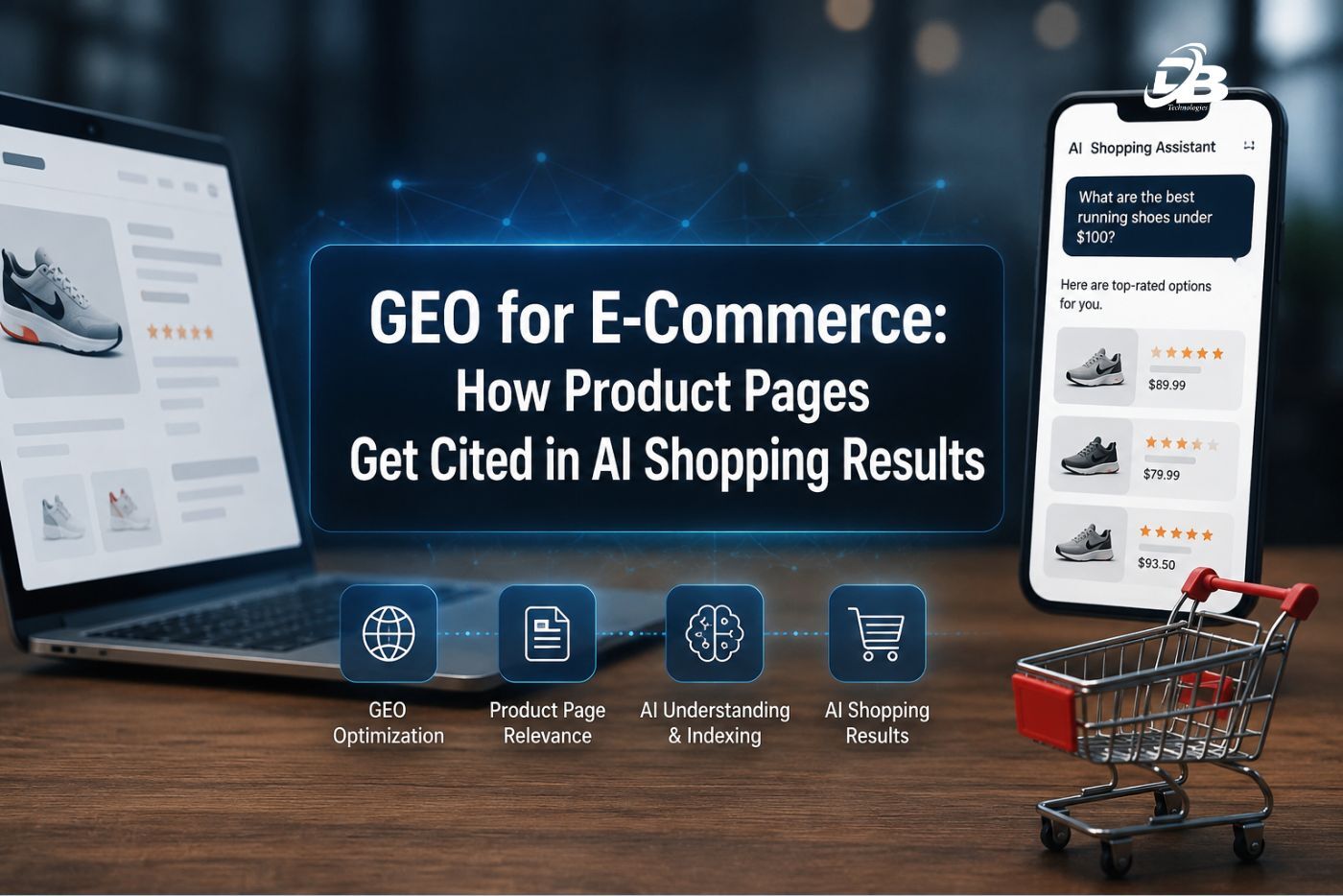
Next time you get bored, you can give this a try. Go to ChatGPT and ask the question: “The best noise-cancelling headphones under $150.” Do not Google it; just ask.
You’ll get an answer. Two or three products, maybe with a quick reason for each one, sometimes a link. No scrolling through ten blue links, no squinting at sponsored ads that look suspiciously like real results. Just… an answer.
Now ask yourself: would your product have shown up in that answer?
For most stores, the honest response is “probably not, and I don’t even know why.” That’s the gap this article is about. It’s called GEO—Generative Engine Optimization. GEO for ecommerce is quickly becoming as important as traditional SEO if you want your products to appear in AI-generated shopping recommendations Maybe more.
Wait, What Even Is GEO?
Quick definition, then we’ll get into the useful stuff.
GEO for ecommerce is the practice of shaping your product pages and store content so that AI tools — ChatGPT, Perplexity, Google’s AI Overviews, Amazon’s Rufus — can pull your products into their answers and recommend them by name.
Old-school SEO earned you a ranking. Page one, a click, hopefully a sale. GEO plays by different rules. The AI reads your page, weighs whether it trusts what’s there, and either names your product or leaves it out entirely. There’s no page two to fall back on here. That’s precisely why AI-powered shopping optimizations are high on the to-do list of brands looking to get noticed.
No longer is generative AI just a fad or niche phenomenon – it is transforming the way people shop online. According to Adobe Digital Insights, AI-fueled traffic to U.S. retail websites saw an unprecedented 4,700% rise through mid-2025. To make matters worse, AI-fueled shoppers convert around 31% higher compared to ordinary organic search traffic. Put differently, consumers looking for recommendations from ChatGPT or some other AI are already far more likely to buy something than just your average Google user.
So yeah. Worth paying attention to.
How Is This Actually Different From Regular SEO?
I can understand the goalie fatigue from moving goal posts. Google updates its search algorithm, you tweak, it tweaks, you tweak. So what’s the point in GEO being any different?
This is the actual difference. Normal search engines are able to perform keyword matching and ranking based on features such as backlinks and click behavior. Instead of a researcher reading through a stack of sources, selecting the good ones, and summarizing them in her own words, AI Shopping Tools operate more as a reader who has chosen the trustworthy sources and then summarizes. Not optimizing your page.The question here is whether you should or not.
This means that a web page can do really great on Google rankings and be entirely ignored by ChatGPT. According to research, AI usually gets its information not only from the first pages of the search results on Google but also from other sources.
Being first on Google buys you almost nothing here. That also means product page SEO for AI goes beyond ranking for keywords—it focuses on giving AI systems enough trustworthy information to confidently recommend your products.
A few other things that are genuinely new:
Speed. Old-school SEO could take six months to a year to show results. GEO tends to move faster — sometimes visible in as little as 30 to 60 days — because AI tools re-crawl and re-evaluate sources far more often than Google re-indexes a page.
Trust over tricks. You can’t really keyword-stuff your way into an AI answer. These systems are checking whether your claims are specific, verifiable, and backed by actual data — reviews, certifications, real numbers. Vague marketing language tends to get quietly skipped.
It builds up, it’s not one and done. GEO is not a one-time campaign. It is more like the continuous maintenance which would involve keeping the inventory data updated. It’s not set and forget because it has to be adjusted from time to time.
It’s more like inventory data: something that is kept rather than completed.
AI shopping optimization is not about algorithms. It is about making your product information understandable, verifiable and citable by AI assistants.
So How Do Product Pages Actually Get Cited?
This is what everyone really wants to know, so here are some concrete suggestions.
1. Answer a question before it’s even asked
AI models don’t reward pages that talk about a product in vague, brand-voice terms. They reward pages that answer a specific question clearly, in the first few sentences.
Consider how people actually type into ChatGPT. Almost nobody writes “premium artisanal skincare solution.” They write “best moisturizer for oily skin that won’t cause breakouts.” Your page needs to speak roughly that second language, not the first.
An easy remedy: craft the first line of your product description to address the question a shopper might be asking. Rather than “Crafted with care using the finest natural ingredients,” it would be more accurate to say, “This moisturizer is formulated specifically for oily and acne prone skin – it uses non-comedogenic ingredients which do not clog pores.” Same product. Fairly different odds of getting cited.
2. Structured data isn’t optional anymore
“Schema markup” sounds like a developer’s problem. It isn’t, and this one matters more than almost anything else on this list.
For many brands, structured data has become one of the most important parts of product page SEO for AI, because it removes ambiguity from product information.
Schema markup — specifically Product, Review, and FAQ schema — works as a kind of translation layer. It tells AI systems, in a format they can read instantly, what your product actually is: price, stock status, and what real customers said about it. Without that layer, an AI is left guessing at your page’s meaning from loose text. Sometimes the guess is wrong. The page will frequently be skipped over.
This is mostly all doable with an application or extension installed on either Shopify or WooCommerce without writing any code. The important fields appear to be: price, availability, variants, GTIN or MPN number, and customer reviews.
Keep them current, too, schema claiming “in stock” on an item that’s been sold out for three weeks is arguably worse than having no schema at all, since now the AI is citing something inaccurate, and that tends to erode trust fast.
3. Be specific, not impressive
This is the single biggest mindset shift for most brands. Marketing copy has spent decades optimizing for “sounds good.” GEO rewards “is true and checkable.”
Compare these two lines:
“Our jackets are designed to resist the weather conditions.”
to
Waterproof up to 10,000mm hydrostatic pressure, temperature resistance down to -10°C.
The second one is dull according to the standards of ad-copy. It’s also exactly the kind of sentence an AI can lift, trust, and repeat when someone asks “what jacket handles heavy rain in cold weather.” Numbers, certifications, test results, materials, specific use cases — that’s the vocabulary AI systems are built to extract.
4. Reviews matter more than you’d think — but only real ones
AI tools weigh review content heavily because a review is independent verification. A product description says what you claim. A review says what actually happened.
Generic five-star reviews (“Great product! Fast shipping!”) add almost nothing. What helps is detail: specific use cases, specific outcomes, maybe even a minor downside. “Runs slightly small, ordered a size up and it fit perfectly” does more work for an AI system than “Love it!!!” — it answers a real question a future buyer might have.
If you can prompt customers for more detailed feedback — a follow-up email with two or three specific questions instead of “rate us 1-5” — it’s worth doing. Helps your GEO. Helps actual humans reading your reviews too.
5. Build content that earns authority, not just traffic
Content that is in the form of buying guides, comparison pages, and FAQs also frequently do very well in AI citations as they address questions that people ask in conversations that are often split into multiple parts. Running Shoes For Flat Feet In Under $ 150 isn’t a product page query. It’s a buying-guide query.
A well-built guide — one that honestly compares options, including situations where your product isn’t the best fit — tends to earn more trust from AI systems than a page that only pushes its own catalog. The opposite may seem true, yet it is similar to how it works for humans: the source that allows nuances gains more credibility.
Buying guides, frequently asked questions (FAQs), and comparison pages will be helpful in your AI shopping optimization strategy as well, as they cover all the questions that customers would ask an AI assistant.
6. Stay current — outdated pages get quietly dropped
One aspect that may cause problems for brands is that a product page may look perfect upon its launch but will eventually become obsolete due to fluctuating prices, changing stock, or product updates.
AI systems tend to favor freshness. A page that hasn’t been touched in eighteen months, with a price that no longer matches your checkout, is a page these tools learn to stop trusting.
Set a recurring reminder, quarterly is reasonable for most catalogs — to review your top product pages for accuracy. It’s a non-heroic job, but a job that gets the job done.
What About Measuring Any of This?
Fair question, and honestly, measurement is the weakest link in most brands’ GEO efforts right now. Only around 16% of brands are systematically tracking AI search performance at all, so if this hasn’t started for you yet, that puts you in the majority — not behind some curve everyone else has already figured out.
A couple of quick and easy things to get you started:
– Make use of manual queries to your top 10-15 buyers once a month in AI tools (ChatGPT, Perplexity, Google AI Mode).Check if your brand is mentioned, if the description is correct.
– Watch for new referral sources in your analytics. Traffic from chatgpt.com or perplexity.ai showing up as a referrer is worth tracking separately from your usual organic numbers.
– Look at add-to-cart rate and average order value specifically from AI-referred sessions, not only last-click conversions. GEO seems to influence the research stage of a purchase more than the final click, so judging it purely on last-click sales tends to make it look weaker than it probably is.
None of this needs to be fancy. A simple spreadsheet updated monthly beats no tracking at all, and it beats it by a lot.
Where To Start
If all of this feels like a lot, it kind of is, but you don’t need to fix your whole catalog at once. Pick your five best-selling products and do this:
– Rewrite the opening two sentences of each description to directly answer a real buyer question.
– Add or verify Product and Review schema markup.
– Replace a generalization or a claim with a concrete piece of information.
– Ask three of your recent clients to provide you with their feedback using specific questions.
– Run one query for each product through ChatGPT and see what comes back.
These small improvements create a solid foundation for product page SEO for AI without requiring a complete overhaul of your ecommerce store.
AI shopping isn’t a future trend anymore, and AI shopping optimization is becoming just as essential as traditional SEO for online stores. It’s just how a growing number of people shop now, quietly, in a chat window, before they ever open your website.
The brands showing up in those answers aren’t necessarily the biggest ones. They’re the ones whose product pages actually tell the truth, clearly, in a format a machine can read. That’s a fairly achievable bar. Might as well clear it.



 +971 582 871635
 +971 582 871635