

There’s this frustrating thing that happens in SEO. You do everything right — you target the right keywords, you build some decent links, you publish content that’s genuinely useful — and you still watch a competitor with a weaker page outrank you. Every single time.
For a while, that’s only confusing. However, the more you explore the inner workings of Google today, the more of a pattern you’ll start to see.
Google isn’t just reading your pages anymore. It’s trying to figure out who you are. Not which keywords you’re going after — but whether your brand is a real, recognizable, trustworthy entity in your space. That distinction matters more than most SEO guides let on.
That’s entity SEO. And understanding it can probably explain a lot of the ranking movements you’ve been scratching your head over.
So What Actually Is Entity SEO?
An “entity,” in the way search engines use the term, is any distinct real-world thing. A person. A company. A place. A concept. A product. Google’s Knowledge Graph is basically a large graphic of entities, and the relationships among them.
If Google has its data right, “Spotify” is associated with the term “streaming music”, “Daniel Ek”, “Sweden”, and “freemium model”, that’s one of those entities, right? The clearer the ideas are about such relationships, the clearer will be Google’s understanding of that entity.
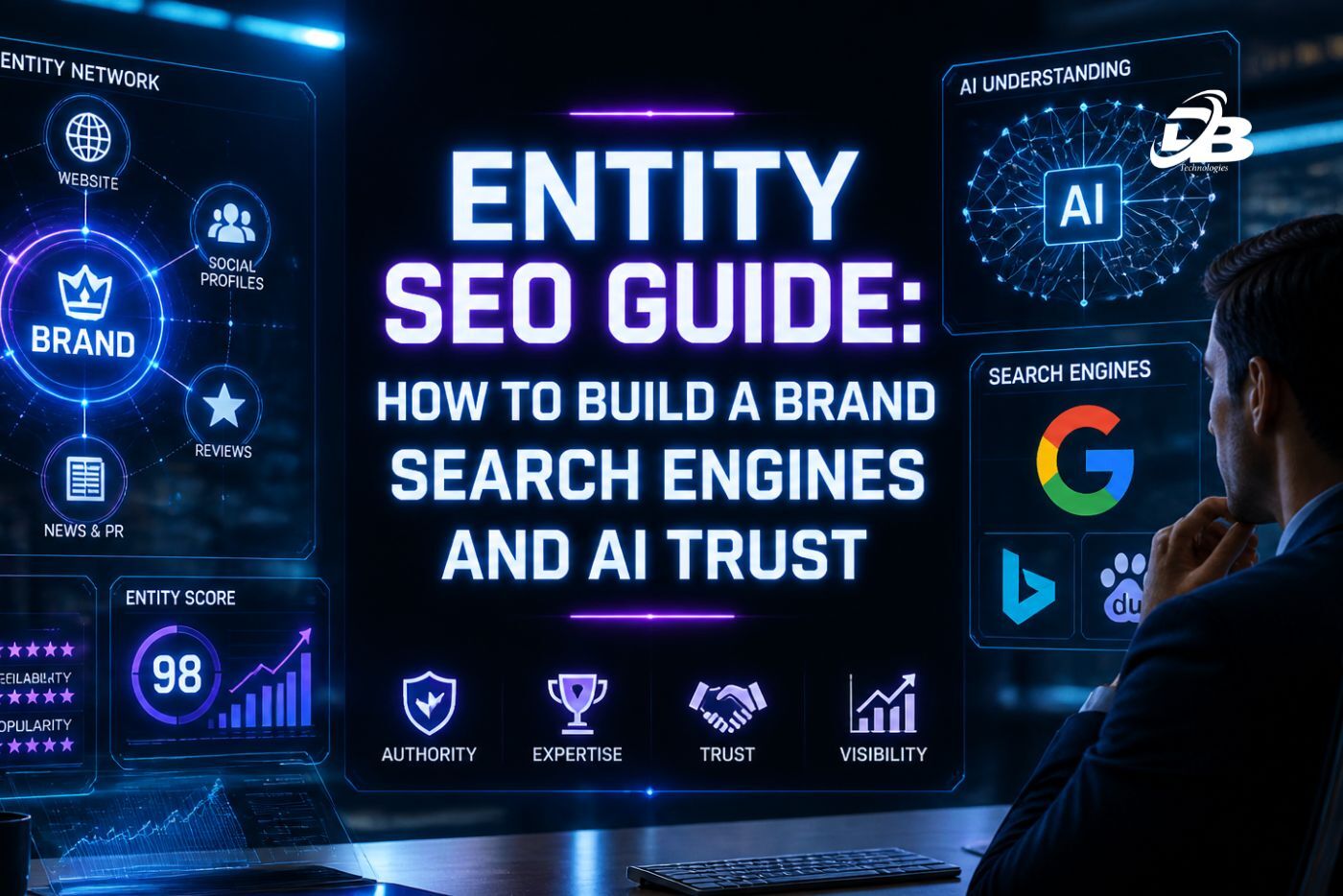
Entity SEO, then, is the practice of making sure Google understands your brand as a clearly defined, trustworthy entity in your niche. Not just “this website covers topic X” — but “this brand is a recognized authority on topic X.”
We should also distinguish this from the semantic SEO which usually operate more on the content level, make sure that each content piece communicate well to the computer. Entity optimization goes a level above that — it’s about what your brand is, not just what any given page says.
They work together, though. One without the other tends to leave something on the table.
Why This Feels More Urgent Now
Five years ago, entity SEO was the kind of thing advanced practitioners talked about at conferences. Most brands could do fine without thinking about it too deeply. That’s probably less true today.
Part of the reason is how radically search has changed. Google’s earlier updates — Hummingbird back in 2013, then RankBrain, BERT, MUM — were all moves in the same direction: away from keyword matching and toward understanding meaning, context, and intent. Google got very good at understanding what a page is about. What it’s still figuring out, in some ways, is who wrote it and whether that source can be trusted on this particular topic.
Then there’s the AI layer. Tools like Google’s AI Overviews, Perplexity, ChatGPT search — these aren’t ranking pages in the traditional sense. They’re synthesizing information and presenting it as a direct answer, often without sending the user anywhere. For your brand to appear in those answers, being findable isn’t quite enough. You more or less need to be known — a recognized, trusted entity that the underlying models have learned to associate with your topic area.
How AI search understands brands is, genuinely, one of the more important questions in digital marketing right now. And the uncomfortable answer is that it starts long before anyone types a query.
The Knowledge Graph: Think of It as a Digital Identity File
Here’s a way to think about knowledge graph SEO that makes it a bit more concrete.
Google’s Knowledge Graph is a repository of information about entities and their relationships, which is continuously added to. This is Google bringing you back to the right side of the search results, a panel of the brand, its description, founding date, social profiles, related people, etc. — Google is showing you what it has been confident about mapping about this entity.
While the Knowledge Panel is sometimes regarded as a vanity win, it’s not.It signals that Google has enough structured, verified information about your brand to present it confidently. That confidence also tends to affect how your content is treated in search more broadly — including in AI-generated answer surfaces where your brand either gets named or doesn’t.
Knowledge graph SEO, then, is partly about consistently feeding Google the signals it needs to build that confident picture of you. Less noise. More clarity.
How to Build Entity Authority for SEO
Right. Enough framing. Here’s what you can do about it.
1. Get Your Brand’s Core Identity Consistent — Everywhere
This one sounds almost too obvious to mention. But it’s where a surprising number of brands have problems, often without realizing it.
Google builds its model of your brand entity by pulling signals from across the web. Your website, your social profiles, your Google Business Profile, third-party directories, press mentions, review sites. If your brand name, description, or category is inconsistent across those places — slightly different phrasing here, an old logo there, a different “company type” on LinkedIn versus your homepage — that creates noise. Ambiguity. And ambiguity is the enemy of entity optimization.
Start with a simple audit. How does your brand describe itself on your homepage? Does that match LinkedIn, Crunchbase, your Google Business Profile, your Twitter bio? It probably doesn’t, completely. Tightening that up is unglamorous work, but it directly strengthens your brand entity signal.
2. Use Schema Markup to Say Explicitly What You Are
One of the most obvious ways to tell search engines what kind of entity you are is schema on your homepage, which in this instance is Organization.
As a bare minimum, your Organization schema should have your brand name, website URL, logo, founding date, and contact details.. The sameAs property is particularly worth paying attention to. It lets you link your entity to its profiles on authoritative external platforms — LinkedIn, Twitter, Facebook, Wikidata, Crunchbase — which helps Google connect all your brand’s digital presences into a single, coherent entity.
Does schema markup directly boost rankings? Probably not in a straightforward way. But it reduces ambiguity. It’s essentially handing Google a structured form that says “here’s exactly what kind of entity we are.” In a world where Google is trying to map entities and relationships, that kind of clarity tends to help.
3. Get Mentioned in Authoritative, On-Topic Sources
One of the stronger signals for brand entity authority is being genuinely referenced — mentioned, cited, named — in authoritative sources within your field. Not just linked to. Mentioned.
Think about how trust works in real life. The words that people use to describe themselves are somewhat influential. What other credible people say about them carries considerably more. The same logic tends to apply to entity optimization.
This means you want — over time — features and references in relevant industry publications, citations when others write about your research or data, appearances in podcasts and expert roundups, reviews on trusted third-party platforms. These unlinked brand mentions appear to help Google understand what your brand entity represents in context, not just what your own site claims.
Worth noting: this can’t really be rushed or manufactured. The signals Google finds most useful seem to be the ones earned through actual presence in a field, not the ones assembled through aggressive PR blitzes.
4. Build Topical Depth — Not Just Content Volume
Entity SEO and topical authority are more connected than they might seem at first.
Google doesn’t just want to know what type of entity you are. It wants to know which topics your entity can be trusted on. The way it builds that picture is by looking at the breadth and consistency of your content over time — not individual pieces, but the cumulative pattern.
If you run a fintech company and you’ve published two years of substantive content covering everything from open banking regulations to consumer credit scoring to embedded payments — Google starts to recognize your brand entity as an authority in that space. Your entity gets associated with that topic cluster in the Knowledge Graph.
This is where semantic SEO and entity optimization genuinely reinforce each other. Semantic SEO helps individual articles rank well. Entity SEO helps your brand become the recognized source on a topic. You need both. One without the other tends to plateau.
The practical implication: pick a topic territory and go deep. Cover it from multiple angles. Build content that connects to other content on your site. Spreading thin across unrelated subjects almost certainly works against your entity authority.
5. Build Author Entities — Not Just a Brand Entity
Named, real authors with their own digital footprints can meaningfully strengthen your brand’s entity credibility. This is something a lot of companies skip entirely, which seems like a mistake.
Google’s E-E-A-T framework — Experience, Expertise, Authoritativeness, Trustworthiness — puts real weight on demonstrable human expertise behind content. When the people writing for your brand have their own visible presence — proper author bio pages, LinkedIn profiles, bylines on other publications, areas of clearly defined expertise — that adds a layer of entity credibility that a brand alone can’t provide.
Practically: make sure authors have bio pages that link out to their professional profiles and any other publications they’ve written for. If possible, have them contribute to outside publications so their individual entity builds credibility that isn’t entirely dependent on your brand.
6. Wikidata Is Probably More Important Than You Think
Most people know about Wikipedia’s relevance to brand credibility. Fewer pay attention to Wikidata, which might actually matter more for entity purposes.
Wikidata is Wikipedia’s machine-readable, structured database. It’s a direct source Google pulls from when building the Knowledge Graph. Adding your brand to Wikidata — and keeping that entry accurate — is a reasonably direct way to influence how your entity is understood by Google and, likely, by AI search models trained on similar data sources.
Wikipedia requires demonstrated notability — significant, independent media coverage — and rejects anything that reads as promotional. If that bar is achieved then it is worth doing. If it isn’t, then Wikidata is still useful and the notability criteria are less likely to be met by well-known brands than household names.
Also read our blog titled , “AI Search Visibility Audit Checklist: How to Prepare Your Website for 2026.”
Entity Optimization for AI Search: The Part Most Guides Skip
Here’s where things get a little different from traditional SEO thinking.
AI search tools don’t index pages the same way. They’re trained on large datasets, and during that training, they form internal associations between entities, topics, and credibility signals. Those associations are baked into the model before anyone asks it a question.
In practice, having a brand appear in an AI-generated response requires you to first be consistently linked to the high-quality, accurate information that may be used in training or updating a model. What a model learns in training is out of your control. But you can influence the information environment that training data draws from.
That means: being cited in the kinds of sources AI training datasets tend to pull heavily from — Wikipedia, major industry publications, government or academic references. Having a brand description clear enough that a model can confidently categorize what you do. Building enough genuine presence that your entity becomes a recognizable signal for your topic.
The short version: the same signals that strengthen your brand entity in Google’s Knowledge Graph are probably the same signals that help AI models learn to associate your brand with your topic area. Entity optimization for AI search and traditional entity SEO are, for most practical purposes, the same thing.
How do you know if it’s working?
Unfortunately, there is no single clean measure of entity authority. But there are a few useful things to watch.
Your brand’s Knowledge Panel. Does one exist? Does it accurately reflect your current description, key people, and offerings? Gaps or inaccuracies there are worth fixing.
Your brand SERP. Search your exact brand name and look at what fills the top ten results. Ideally it’s your own properties and trusted third-party references. If it’s cluttered with unrelated content or competitor comparisons, your brand entity signal may still be weak.
AI answer presence. Manually test this periodically — ask AI tools questions about your core topics and see if your brand gets named. Anecdotal, but informative over time.
Brand mentions across the web. You can use a Google News alert, Ahrefs or Semrush to keep an eye on how frequently your brand is talked about in the news, including without a link.
None of these are perfect proxies. But together they give you a reasonable sense of whether your entity is becoming more recognizable to search and AI systems.
The Honest Thing About This Strategy
Entity SEO is a long game. It doesn’t produce results in a week or even a month. There’s no quick technical fix, no single piece of content that suddenly makes search engines “understand” your brand.
What it does produce, over time, is something genuinely defensible. A competitor can replicate your content strategy. They can target the same keywords, build links at the same rate, copy your site structure. What they can’t quickly replicate is years of consistent brand presence, authoritative mentions, structured data clarity, and a coherent topical identity that both humans and machines have learned to recognize.
That’s the actual value of building entity authority for SEO. The brands most visible in search in a few years from now are likely the ones who started treating their brand as an entity worth building — not just a URL worth optimizing.



 +971 582 871635
 +971 582 871635