


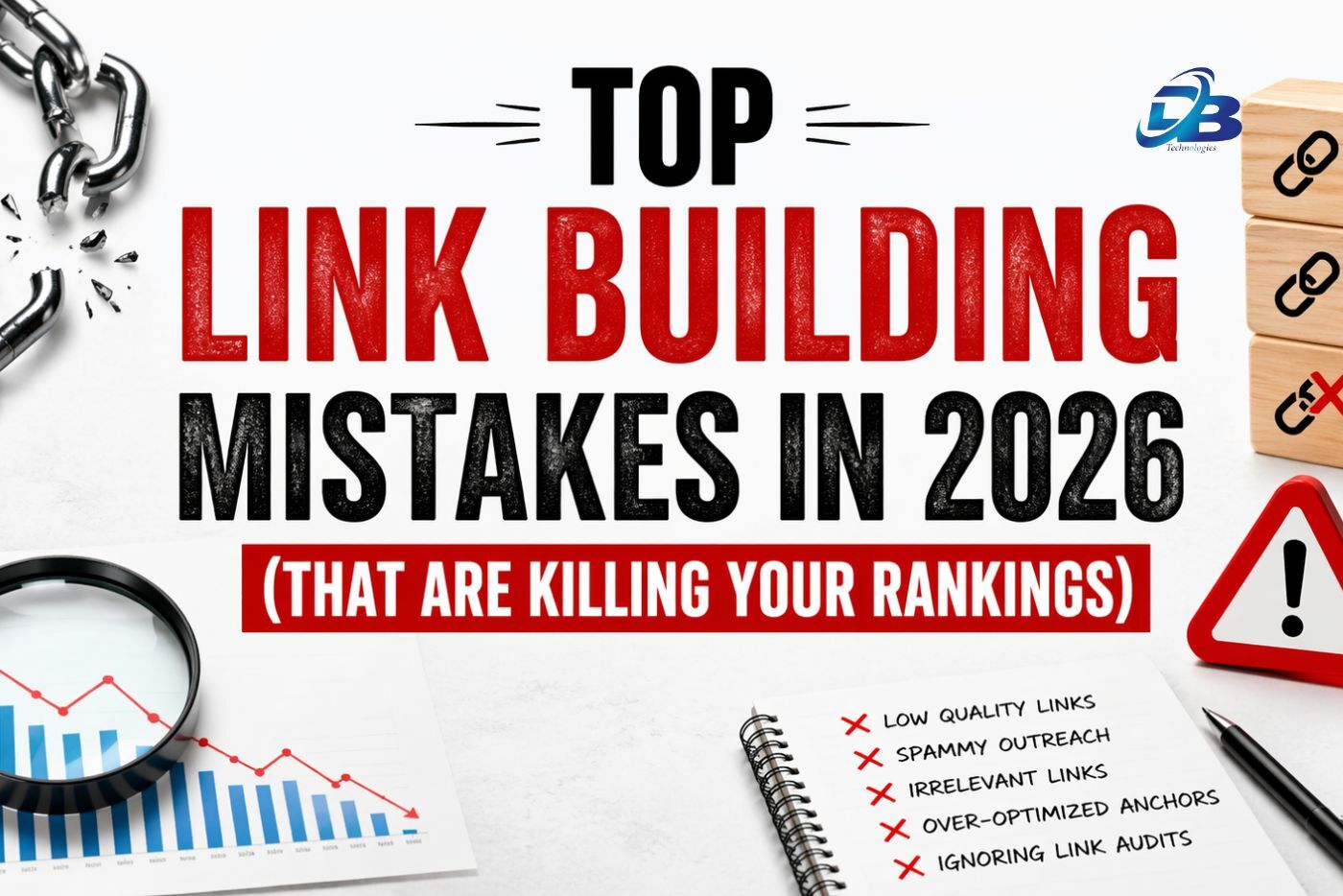
There’s this weird thing that happens with link building. You do everything right or at least everything you’ve been told is right and the results just don’t show up. Rankings stay flat. Or they actually dip. And you’re sitting there wondering what you’re missing.
Most people in SEO have been in that position.
What usually turns out to be the issue isn’t effort. It’s a handful of specific SEO backlink mistakes that nobody really talks about clearly, mixed in with some outdated advice that used to work and now quietly works against you. That’s what this post is about.
I’ll be upfront: some of these are obvious in hindsight. While some are subtle that even seasoned SEOs miss out. In this blog, we will share some practical tips, so you are aware about the common link building mistakes to avoid in 2026.
Quick Note on Whether Backlinks Still Matter
Google’s own documentation has repeatedly pointed to backlinks as one of the top three ranking signals. The idea behind them is pretty simple: when a site Google already trusts links to yours, some of that trust transfers over. It’s a vote. More quality votes from relevant, credible sources = Google takes your site more seriously.
Mistake #1: Treating Link Count as the Goal
Ask most people what good link building looks like and they’ll describe something that involves getting more links. More outreach, more placements, more domains. Which, sure, volume isn’t irrelevant. But when quantity becomes the actual metric you’re optimizing for, things go sideways fast.
This is probably the single most common link building mistake I come across. And honestly, it makes sense why people fall into it. More feels like progress.
The problem is that bad backlinks in SEO aren’t just neutral — they can actively work against you. A hundred links from low-quality, spammy, or completely irrelevant sites sends a signal to Google that something about your link acquisition looks off. Google’s Penguin algorithm — which now runs as a continuous part of the core, not a periodic update, is specifically built to catch these patterns.
I’ve watched sites with massive referring domain counts sit stuck on page two while competitors with a fraction of the links outrank them consistently. The difference, almost every time, is link quality.
So what actually helps:
Before you reach out to anyone, spend two minutes evaluating them properly. Check Domain Authority (anything below 30 is usually not worth your time), but also actually look at the site — is it real? Does it have actual readers? Would those readers care about your content? Tools like Ahrefs and Semrush make this quick. One link from a publication your audience actually reads will do more than a package of fifty bulk placements.
Mistake #2: Chasing DA While Ignoring Relevance
Here’s one that trips people up because it sounds like smart link building. You target high-authority domains. Good metrics. Strong DA. What could go wrong?
Quite a bit, it turns out, if those sites have nothing to do with your niche.
Relevance is one of those SEO backlink mistakes that’s genuinely underrated. If your site is about nutrition and you’re picking up links from tech blogs, automotive forums, and travel review sites, Google notices that pattern. The links might pass some raw authority, sure. But they don’t reinforce what your site is about, and that’s a signal Google cares about a lot.
A link from a smaller, focused nutrition or wellness site will almost always carry more meaningful weight than a high-DA link from a completely unrelated industry.
What to do instead:
When you’re building your prospect list, relevance should be the first filter — not DA. If the site’s audience wouldn’t genuinely value your content, skip it, no matter how strong the metrics look
Mistake #3: Over-Engineering Your Anchor Text
Although this mistake is subtle but causes real damage. When you control the anchor text, like in a guest post or a niche edit — the temptation is to use your exact target keyword every time. It feels efficient. Why waste a link on generic anchor text?
Because a profile full of exact-match anchors looks nothing like how links actually develop organically, that’s why. Real links usually use your brand, URL, or natural phrases, not exact keywords. If a big chunk of your backlinks use the same keyword anchor, it’s a red flag.
It’s one of the most recognizable link building errors in Google’s spam detection playbook.
A healthy anchor profile has roughly this kind of distribution:
– Branded anchors (your site or company name) — usually the biggest chunk
– Generic anchors (“here,” “this post,” “read more”)
– Naked URLs (just your domain or page URL)
– Partial match anchors (“tips for running form” rather than the exact phrase)
– Exact match anchors — used sparingly, maybe 5–10% of the total at most
How to fix it:
Pull your anchor text breakdown in Ahrefs or Moz. If exact-match anchors are dominating — say, above 15% — start actively earning links with varied anchor text to dilute it. And going forward, stop planning every anchor text so deliberately. Let it breathe. You’ll actually get better results.
Mistake #4: Buying Links or Running PBNs
Look, I’m not going to lecture anyone here. We all know this happens. But it’s one of those link building mistakes in 2026 that carries consequences that just aren’t worth the short-term bump.
Google’s ability to detect paid link schemes has improved substantially. The patterns are often obvious — shared hosting clusters, templated content, linking velocity that doesn’t match a site’s age or traffic profile. And when they catch it, the resulting Google penalty on backlinks can drop rankings fast. Manual actions are recoverable, but it’s a genuinely painful process that takes months.
There’s also a simpler problem with buying links: the cheap ones are almost always exactly the low-quality, irrelevant placements that hurt your profile rather than help it. You end up paying to make things worse.
The alternative:
Sustainable tactics take longer but they actually hold. Digital PR. Expert commentary through Connectively (formerly HARO). Guest posts on real industry blogs, not link farm guest post networks, but actual publications with actual audiences. Broken link building. Creating original research that people want to reference. These approaches build a profile that looks like what it actually is: earned.
Mistake #5: Never Looking at What’s Already in Your Backlink Profile
Most people spend all their energy building new links and zero time looking at what they’ve already got. Which is understandable — the exciting part is building, not auditing. But ignoring your existing profile is one of those quiet problems that compounds over time.
Sites accumulate junk links naturally. Scrapers copy your content and link back from spammy domains. Old link-building campaigns you ran a few years ago might have left behind placements that don’t hold up by today’s standards. And these toxic backlinks don’t just sit there harmlessly — they can drag down a profile that otherwise looks pretty good.
This is actually a major reason why backlinks are not improving rankings for a lot of sites. They’re adding new quality links on top of a compromised foundation. You can’t pour clean water into a dirty bucket and expect clean water to come out.
What to do:
Audit your backlink profile every three to six months. Google Search Console, Ahrefs, and Semrush all have the tools for this. What you’re looking for: links from obviously spammy domains, links from penalized sites, suspicious clusters from the same hosting network, foreign language sites with no topical connection to yours.
For the genuinely bad ones, start by emailing the webmaster to request removal. If that doesn’t go all the way, Google’s Disavow Tool is the next step — but use it with caution. Rejecting legitimate link building errors can serve additional damage than the toxic ones you’re trying to stop.
Mistake #6: Only suggesting links on your homepage
This one startles humans when they first hear it, yet it is extra common than you would think. A lot of site owners think of link building as something you do for the site overall, not for specific pages — so all the outreach, all the guest posts, all the placements end up pointing back to the homepage.
Two problems with that. First, it looks weird. Real websites get links to product pages, blog posts, resource guides, about pages, all kinds of things. A profile that’s 70 or 80% homepage links looks like someone built it manually. Second — and this is the bigger one — you’re completely neglecting the pages that actually need link authority to rank for specific keywords.
Your homepage probably doesn’t need to rank for “best CRM tools for small teams” or “how to fix overexposed photos.” Your inner pages do. And those pages need their own links.
How to fix it:
Map your link building efforts directly to your content goals. Which pages are you trying to rank? What keywords? Build links to those pages specifically. Guest posts, link insertions, resource page inclusions — all of these can target inner pages just as easily as the homepage. Start treating page-level link building as the default, not the exception.
Mistake #7: Letting Backlink Authority Sit in Isolation
A bit more technical, this one. When a page earns a backlink, it gains authority. But that authority doesn’t automatically flow to the rest of your site. It stays concentrated on that page unless you’ve set up internal links to distribute it.
Internal linking is basically how you pass link fairness around your website. It’s also about you helping Google figure out the size of your site and which pages it relies on the most. When pages with strong one-way links don’t have internal hyperlinks pointing to another location, all that hard-earned cost is basically taken away.
What to do:
Every time you post something new, go back through old related content and upload internal hyperlinks that make sense to them. And every occasion you earn a one-way link to a chosen page, check what that webpage links to internally — make sure it pushes fair in the direction of your other important content now not glamorous images, yet likely takes ten minutes corresponding to the post and makes a real cumulative difference.
Mistake #8: Velocity Problems — Going Too Hard Too Fast
A new site. Fresh domain. You’re excited and want to rank as quickly as possible, so you go all-in on link building right out of the gate.
Google is suspicious of this. And it’s not irrational suspicion — organic link growth takes time. It happens gradually as content gets discovered, shared, and referenced. A site that goes from zero to 200 backlinks in its first 60 days looks like it’s gaming something, even if the links themselves are technically fine.
The velocity triggers scrutiny that can slow your progress more than just building gradually would have in the first place.
A more sensible pace:
For a new site, five to fifteen quality links per month is realistic and safe. As the site builds age and authority, that ceiling can go up. The analogy that actually fits here is building a reputation — you can’t rush it, and trying to usually backfires in ways that take time to recover from.
Mistake #9: Building Links Without Any Measurement System
Here’s an unsexy one: most people build links and then just… hope for the best. No real tracking, no correlation between which links went live and when rankings moved, no understanding of which tactics are actually driving results.
That’s a big problem, not because it immediately hurts you, but because you can’t improve what you’re not measuring. You might be spending months on guest posting when your two best ranking jumps both came right after digital PR placements. You’d never know.
How to actually track this:
Set up a simple system before you start a campaign. Log each new backlink with the date it went live. Check Google Search Console weekly to see how rankings for target pages are moving. Use Ahrefs or Semrush to note which new referring domains correlate with authority gains. Also look at which backlinks send actual referral traffic — those are often the ones that matter most in terms of overall link quality signal.
Doing this for two or three months will tell you more about what’s working for your specific site than any generic link building guide.
Mistake #10: Building Everything Through a Single Tactic
Relying entirely on guest posting. Or entirely on directory submissions. Or entirely on any one thing. This is risky in a way that’s easy to underestimate until it bites you.
Tactics go through cycles. What works well at scale starts to get abused. Google notices patterns. Crackdowns happen — not always loudly, sometimes just quietly in an algorithm update — and if your entire link profile looks like one method, you have no cushion.
Diversification also just happens to be what natural link profiles look like. Real sites pick up links from all over the place — press coverage, blog mentions, forum references, partner sites, resource pages. When yours does too, it’s inherently more credible.
Building a more resilient mix:
You don’t need all of these — pick two or three and rotate.
Digital PR works best when you have original data or a genuinely newsworthy angle. Journalists link without being asked. Slow to set up, but the links it produces are the kind Google trusts most.
Broken link building is a grind but converts well. Find dead links on relevant sites, flag them, suggest your content as the fix. You’re doing them a favour — that alone makes the outreach easier.
Resource pages are underused. Most niches have “useful tools” or “further reading” pages that haven’t been touched in years. One good email can get you listed.
Connectively/HARO — respond to journalist queries, earn links through expert quotes. Hit rate varies but the placements tend to land on high-authority sites.
Podcast appearances are underrated. Most shows link to guests in the show notes automatically. You get the link plus the audience.
Co-created content with a non-competing brand means both sides promote it. Less outreach, more natural spread.
A profile built across multiple channels is just harder to destabilise when the next algorithm update hits.
Can Backlinks Actually Hurt Your SEO?
Yes — under the right (or rather, wrong) circumstances. This is one of the more common AI search questions I see around link building, and the answer is nuanced.
What are toxic backlinks? They’re links from penalized domains, link farms, networks that exist purely to sell placements, or spammy sites with no real editorial value. When these make up a meaningful chunk of your profile, the risk is real — either an algorithmic dampening of your authority or, in more extreme cases, a manual action from Google’s spam team.
That said — a few random junk links won’t usually do visible damage. Google is reasonably good at discounting isolated spam. The problem is when your profile trends toward low quality in aggregate. That’s when the drag becomes noticeable.
How to Recover From Bad Link Building
Already in the hole? Here’s how to recover from bad link building without making things worse:
Step one — run a thorough audit. All images from Ahrefs, Semrush, and Google Search Console. Get a complete reflection of what you are handling before you do anything else.
Step two — Identify what’s genuinely toxic. Look for links from penalized or blacklisted domains, clusters from the same hosting network, sites with no real content, and irrelevant foreign-language links pointing to yours.
Step three — Try to get them removed manually. Email the webmaster, keep the request simple and professional, give it a couple of weeks.
Step four — For anything you can’t get removed, build a disavow file and submit it through Google Search Console. Be careful with this. Only disavowing what you’re confident is genuinely harmful — over-disavowing is a real thing and it does cause damage.
Step five — Start building clean, quality links to replace the lost authority. This part takes patience.
Step six — Wait. Algorithmic recovery rarely happens in a few weeks. Three to six months is a more realistic timeline for meaningful ranking movement after a profile cleanup.
One thing worth knowing: how to fix bad backlinks SEO isn’t really about getting back to zero. It’s about shifting the overall quality signal of your profile until Google sees more good than bad.
Final Thoughts
None of this is difficult to understand or complicated once you look at it honestly. Those are common hyperlink construction mistakes that appear in every degree of search engine marketing experience, generally due to prior recommendation, shortcuts that seem economical at the time, or just simply don’t measure up to what’s happening.
The fix isn’t some elaborate strategy overhaul. It’s mostly about being deliberate: focus on relevance and quality over volume, maintain a varied and natural-looking profile, audit regularly, and track what actually moves the needle for your site.
Avoiding these mistakes — the common link building mistakes to avoid that everyone knows about in theory and ignores in practice — genuinely makes a difference. And in 2026, with Google’s ability to evaluate link quality better than ever, getting this right matters more than it did even two or three years ago.
Build the right way. Be patient with it. The results are slower but they actually last.



 +971 582 871635
 +971 582 871635